
Key Takeaways
Automated Contract Review: AI agents extract, analyze, and interpret contractual terms, reducing manual review time.
Proactive Risk Detection: Identify unfavorable clauses, financial exposure, compliance gaps, and hidden contractual risks before signing.
Smarter Negotiations: Generate alternative clause recommendations and support consistent, data-driven negotiations.
Lifecycle Automation: Automate contract creation, review, approvals, renewal tracking, and ongoing obligation management.
Better Decision-Making: Turn historical contracts and contractual data into actionable business insights.
Stronger Governance: Combine AI capabilities with data security, access controls, auditability, and human oversight.
Human Expertise Remains Essential: AI accelerates contract management, while legal professionals retain control over critical decisions and final approvals.
Introduction
Business agreements are at the heart of almost every commercial relationship. From vendor contracts and partnership agreements to service-level agreements (SLAs), employment contracts, and non-disclosure agreements (NDAs), organizations manage hundreds or even thousands of legal documents throughout their operations.
Yet, despite the importance of these agreements, many businesses still rely on manual processes to review contracts, identify potential risks, track obligations, and negotiate terms. These processes are often time-consuming, resource-intensive, and vulnerable to human error.

A single overlooked clause, an unfavorable liability provision, or an unnoticed renewal deadline can create significant financial and operational consequences.
This is where AI-powered contract intelligence is changing the way organizations manage business agreements.
With the emergence of AI agents, businesses can move beyond basic document extraction and automated searches toward intelligent systems that understand contractual language, evaluate potential risks, recommend changes, and support negotiation workflows.
Rather than simply digitizing legal documents, AI agents are making contract management more proactive, efficient, and data-driven.
1. What Is Contract Intelligence?
Contract intelligence refers to the use of artificial intelligence to extract, understand, analyze, and act on information contained in business agreements.
Traditional contract management systems primarily focus on storing documents, organizing records, and tracking important dates. While these capabilities improve accessibility, they offer limited assistance in understanding the actual meaning and implications of contractual terms.
AI-powered contract intelligence takes this further.
Using technologies such as Natural Language Processing (NLP), Large Language Models (LLMs), machine learning, and intelligent document processing, these systems can interpret complex legal language, identify important clauses, compare contractual provisions, and generate actionable insights.
AI agents introduce another level of capability.
Unlike conventional AI tools that respond to individual prompts, AI agents can work toward defined objectives through multiple connected steps. They can retrieve relevant documents, analyze contractual provisions, compare them against organizational policies, identify discrepancies, and initiate appropriate workflows.
For example, when a new vendor agreement arrives, an AI agent could:
Extract key contractual information and obligations.
Identify unusual or unfavorable clauses.
Compare terms against approved contract templates.
Flag potential compliance and financial risks.
Recommend alternative wording for problematic provisions.
Route the agreement to the appropriate legal or business stakeholder.
This transforms contract management from a largely manual administrative activity into an intelligent workflow.
2. Automating Contract Review: From Reading Documents to Understanding Agreements
Contract review is one of the most time-consuming responsibilities for legal and procurement teams.
A typical agreement may contain dozens of pages of legal language, cross-references, conditions, and obligations. Reviewing every provision manually requires considerable attention, especially when organizations manage multiple agreements simultaneously.
AI agents can significantly accelerate this process.
Intelligent Document Analysis
AI agents can process contracts in different formats, including PDFs, Word documents, scanned files, and digital agreements.
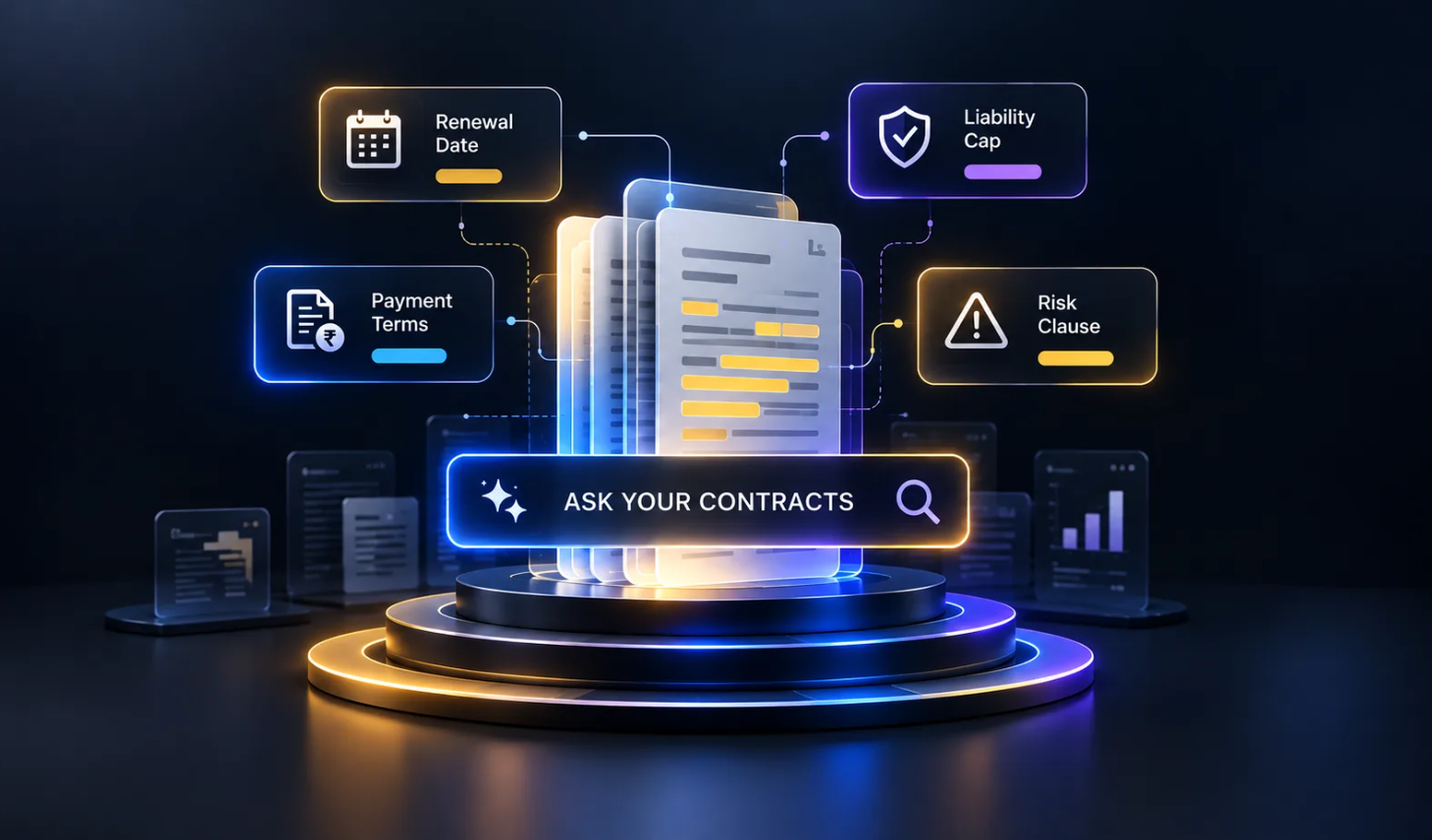
Using OCR, document processing, and language models, they can identify and extract relevant information, such as:
Contract parties and effective dates.
Payment terms and pricing conditions.
Renewal and termination provisions.
Confidentiality obligations.
Indemnification and liability clauses.
Service-level commitments.
Intellectual property ownership.
Governing law and dispute resolution provisions.
More importantly, AI agents can interpret the relationships between these provisions rather than treating them as isolated pieces of text.
For instance, an agent reviewing a technology services agreement could identify a limitation-of-liability clause and examine whether its terms adequately protect the organization against potential service failures.
Comparing Contracts Against Standard Templates
Organizations often maintain approved contract templates to ensure consistency across business agreements.
However, external parties frequently introduce modifications during negotiations.
An AI agent can compare an incoming agreement against the organization’s approved template and highlight:
Removed or modified clauses.
Newly introduced obligations.
Changes to payment conditions.
Unapproved liability provisions.
Differences in termination rights.
Deviations from standard legal language.
This allows legal teams to focus their attention on meaningful changes instead of manually comparing entire documents.
3. Intelligent Risk Flagging: Identifying Problems Before They Become Liabilities
Not every contractual risk is immediately obvious.
A clause may appear commercially reasonable while introducing significant financial, regulatory, or operational exposure when considered alongside other provisions.
AI agents can help organizations identify these risks earlier in the contract lifecycle.
Financial and Commercial Risk Detection
AI agents can examine payment terms, penalties, liability limits, indemnification requirements, and termination conditions to identify provisions that could negatively affect the business.
For example, an agreement might include:
Unlimited liability for certain contractual breaches.
Automatic renewal without adequate notice.
Unfavorable payment deadlines.
Excessive service penalties.
One-sided termination rights.
Unclear pricing adjustment mechanisms.
An AI agent can flag these provisions and explain why they may require further review.
Regulatory and Compliance Monitoring
Businesses operating in regulated industries must ensure that their agreements align with applicable legal and regulatory requirements.
AI agents can evaluate contractual language against predefined compliance frameworks, internal policies, and approved legal requirements.
Depending on the organization’s configuration, they can help identify potential issues involving:
Data privacy and protection.
Information security obligations.
Data processing and retention.
Confidentiality requirements.
Industry-specific compliance provisions.
Third-party and vendor risk management.
For example, a company outsourcing customer data processing may need specific contractual provisions covering data access, security responsibilities, breach notification, and data deletion.
An AI agent can check whether these provisions are present and flag missing or inconsistent requirements.
However, AI-generated risk assessments should be treated as decision-support outputs rather than definitive legal conclusions. Qualified professionals must validate important legal and regulatory interpretations.
4. AI-Assisted Negotiation: Making Contract Discussions More Strategic
Negotiating business agreements often involves repeated document revisions, email exchanges, clause discussions, and coordination between multiple stakeholders.
AI agents can reduce this administrative burden while helping negotiation teams make more informed decisions.
Generating Alternative Contract Language
When an AI agent identifies a potentially unfavorable clause, it can suggest alternative wording based on organizational policies and previously approved contractual positions.
For example, if a vendor agreement contains an unusually broad liability provision, the agent could recommend a more balanced limitation-of-liability clause for legal review.
Similarly, it could suggest adjustments to:
Payment schedules.
Service-level agreements.
Termination notice periods.
Confidentiality obligations.
Data protection responsibilities.
Intellectual property provisions.
These recommendations can help legal teams develop responses faster without starting every negotiation from scratch.

Learning From Previous Negotiations
An organization’s historical contracts contain valuable information about its negotiation preferences.
AI agents can analyze previously approved agreements, rejected clauses, negotiated compromises, and internal playbooks to identify recurring patterns.
Over time, this creates a knowledge base that helps teams understand:
Which contractual terms are generally acceptable.
Which clauses require escalation.
What alternative language has been approved previously.
Which negotiation positions are considered non-negotiable.
Where commercial flexibility is possible.
This allows organizations to approach negotiations with greater consistency.
Supporting Multi-Party Negotiations
Complex agreements often involve legal, procurement, finance, security, and business teams.
AI agents can help coordinate these stakeholders by identifying the departments responsible for reviewing specific provisions.
For example:
Legal teams review liability and termination clauses.
Finance teams assess payment and financial exposure.
Security teams evaluate information security obligations.
Procurement teams examine vendor terms.
Business teams validate operational commitments.
By organizing feedback and identifying unresolved issues, AI agents can help prevent agreements from becoming stuck between departments.
5. Beyond Review: Automating the Entire Contract Lifecycle
The value of contract intelligence extends beyond reviewing and negotiating individual agreements.
AI agents can support multiple stages of the contract lifecycle, from document creation to ongoing obligation management.
Contract Creation: Generate initial agreement drafts using approved templates, predefined business requirements, and relevant contractual information.
Contract Review: Analyze incoming agreements, extract key provisions, and identify deviations from organizational standards.
Risk Assessment: Evaluate contractual exposure and prioritize issues according to predefined risk categories.
Negotiation Support: Recommend alternative clauses, prepare revision summaries, and organize stakeholder feedback.
Approval Management: Route agreements to appropriate decision-makers based on contract value, risk level, and approval policies.
Obligation Tracking: Monitor important deadlines, payment commitments, renewal dates, and service-level obligations.
Post-Signature Monitoring: Notify relevant teams about upcoming contractual milestones and potential compliance gaps.
Consider a company managing hundreds of vendor agreements. Instead of manually tracking renewal dates and reviewing each agreement periodically, AI agents could monitor contractual obligations, identify approaching deadlines, and notify responsible teams before action is required.
This helps businesses move from reactive contract administration to proactive contract management.
6. What Makes AI Agents Different From Traditional Contract Management Software?
Traditional contract management platforms provide useful capabilities, including document storage, version control, electronic signatures, and workflow automation.
However, many traditional systems depend on predefined rules and manual intervention.
AI agents introduce more adaptive capabilities.
| Capability | Traditional Contract Management | AI-Powered Contract Intelligence |
|---|---|---|
| Document management | Stores and organizes agreements | Extracts and understands contractual information |
| Contract review | Relies heavily on manual review | Identifies clauses and potential issues automatically |
| Risk identification | Uses predefined rules | Analyzes context and flags potential risks |
| Contract comparison | Basic document comparison | Identifies meaningful contractual deviations |
| Negotiation | Manual drafting and discussions | Suggests alternative language and negotiation insights |
| Obligation tracking | Calendar-based reminders | Context-aware monitoring and notifications |
The distinction is not that traditional contract management becomes unnecessary. Rather, AI agents add an intelligence layer that makes existing processes more efficient.
The most effective implementations combine AI capabilities with established contract management systems, human expertise, and clearly defined approval workflows.
7. Building Trust: Security, Governance, and Human Oversight
Despite the opportunities, introducing AI agents into contract management requires careful planning.
Business agreements frequently contain confidential information, sensitive financial details, intellectual property, and personally identifiable information.
Organizations must ensure that AI systems operate within appropriate security and governance boundaries.
Important considerations include:
Data Security: Contract documents should be protected through encryption, secure storage, and controlled access.
Identity and Access Management: Access permissions should ensure that employees and AI agents can only retrieve information relevant to their responsibilities.
Data Governance: Organizations need clear policies governing how contractual information is collected, processed, retained, and used.
Auditability: AI-generated recommendations and automated actions should be traceable, with appropriate records of decisions and approvals.
Human Oversight: Legal professionals must retain control over critical legal interpretations, negotiation decisions, and final contract approvals.
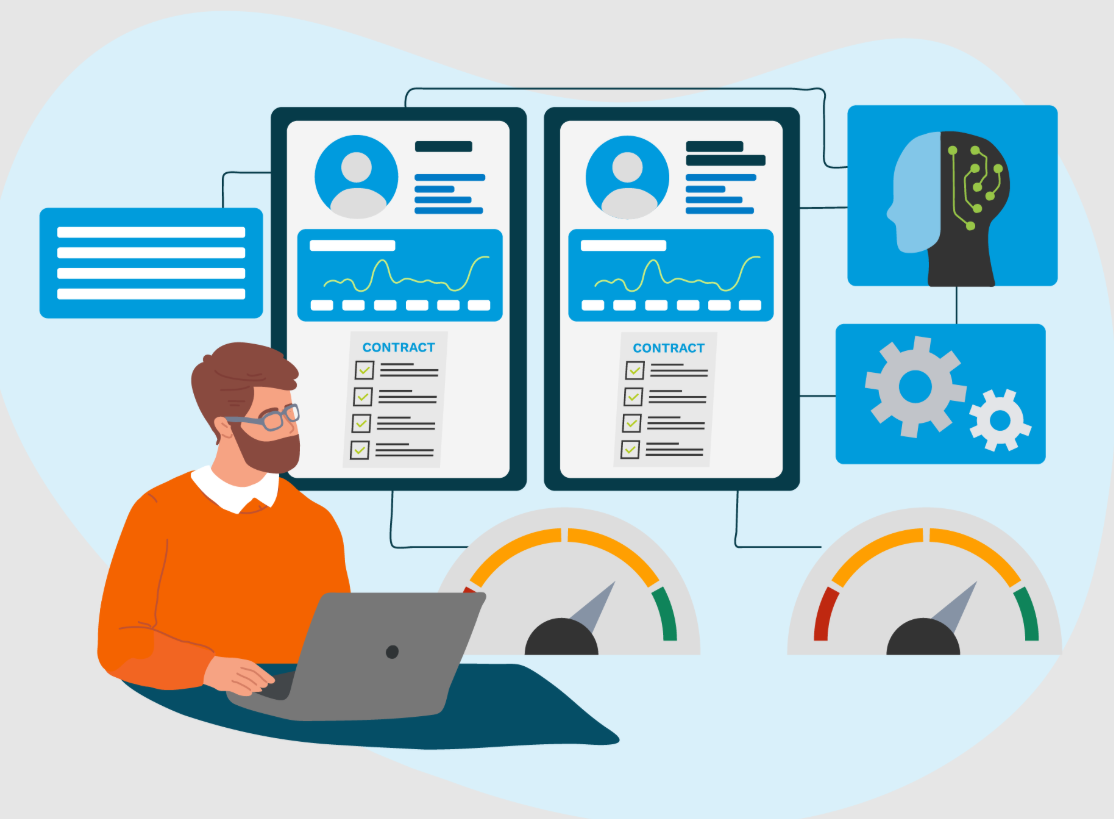
Model Governance: Organizations should evaluate AI accuracy, monitor performance, test for hallucinations, and establish safeguards against unauthorized actions.
A particularly important principle is that AI agents should not independently approve or execute high-impact contractual changes without appropriate authorization.
The objective is not to replace legal expertise. It is to give legal and business professionals better tools to exercise that expertise.
8. The Future of Contract Intelligence: From Document Processing to Autonomous Workflows
The next evolution of contract management will involve interconnected AI agents working across business systems.
Imagine a scenario where an organization receives a new supplier agreement.
One agent extracts the document’s contents. Another evaluates financial and legal risks. A third checks security and compliance requirements. A negotiation agent prepares suggested revisions, while a workflow agent coordinates internal approvals.
Once the agreement is signed, another agent monitors its obligations, tracks renewal conditions, and alerts stakeholders when action is required.
These agents can work together through connected enterprise applications, document repositories, contract management platforms, and business intelligence systems.
This creates an environment where contractual information becomes an active business resource rather than simply archived documentation.
As AI capabilities mature, organizations will increasingly be able to connect contract intelligence with procurement, finance, customer relationship management, enterprise resource planning, and compliance workflows.
The result is a more connected approach to managing commercial relationships.
Conclusion: Turning Contracts Into Business Intelligence
Contracts are more than legal documents. They contain valuable information about business relationships, financial commitments, operational responsibilities, and organizational risks.
Yet much of this information remains underutilized because traditional contract management processes are heavily dependent on manual review and administration.
AI agents offer a new approach.

By automating document analysis, identifying contractual risks, supporting negotiations, and monitoring ongoing obligations, they enable organizations to manage agreements with greater speed, consistency, and visibility.
However, successful adoption requires more than implementing an AI tool. It requires secure infrastructure, reliable data, clear governance, integration with existing business systems, and meaningful human oversight.
The future of contract management is not simply about processing agreements faster. It is about understanding them better, managing risks earlier, and making smarter business decisions throughout the entire contract lifecycle.