
Key Takeaways
- Traditional CRM is a record of the past; agentic customer intelligence is a continuously updated picture of the present — synthesizing email sentiment, support patterns, usage behavior, purchase signals, and billing data into a living profile that surfaces actionable intelligence automatically.
- The churn economics are asymmetric: McKinsey documents a 59% reduction in churn intention and 800% CSAT improvement at a US airline, and a tripling of customer value management revenue at a European telecom operator — both driven by AI detecting behavioral signals before customers had consciously decided to leave.
- 85% of service decision-makers now expect their teams to drive revenue through retention and expansion — a target achievable only when AI surfaces the right opportunity at the right moment with the context to act on it.
- Every customer-facing interaction is multiplied in effectiveness when reps enter conversations with real-time behavioral intelligence rather than a static event timeline.
- Privacy governance is architectural, not optional — consent frameworks, access controls, and transparent data policies are the foundation on which customer trust, and therefore the system’s entire value, depends.
The Abundance Paradox: More Data, Less Understanding
Customer data has never been more abundant, and customer understanding has never felt more elusive. Every interaction generates a signal. Every purchase, support call, email reply, and missed renewal leaves a trace in some system somewhere. Yet when a sales representative opens a customer record to prepare for a renewal call, what they see is a timeline of past events; not a dynamic picture of who this customer is right now, what they need, or whether they are already looking for a replacement.
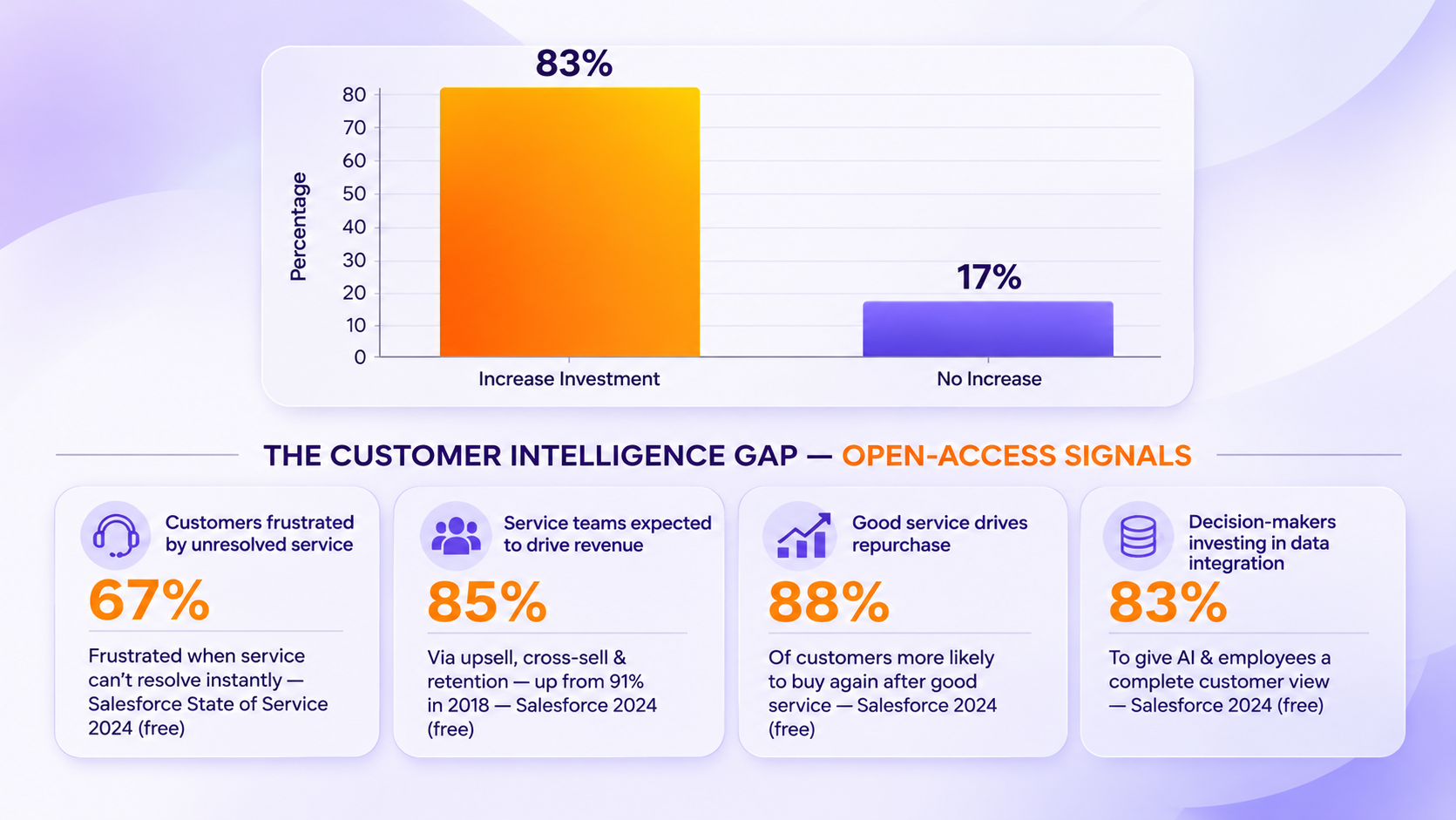
The problem is not a lack of data. It is a failure of synthesis. Traditional CRM platforms were built to aggregate and store, to record what happened. They were never designed to reason about what it means. Salesforce’s 2024 State of Service research found that 83% of service decision-makers plan to increase investments in data integration specifically to give AI and employees a complete view of each customer. The industry has recognized the gap. Agentic AI is the mechanism that finally closes it.
What a CRM Record Tells You — And What It Doesn’t
Open a customer record in any traditional CRM. You’ll see purchase history, support tickets, marketing emails sent and opened, and a note from the last sales call; if the rep remembered to write one. What you won’t see is the customer’s current state: whether usage has declined for six weeks, whether last month’s support ticket signals frustration quietly ripening into a decision to leave, or whether the renewal in 60 days is already at risk.
Two out of three consumers, approximately 67% are frustrated when customer service cannot resolve their issues instantly, and customers walk away from nearly one third of their interactions without getting what they need. That frustration rarely announces itself loudly. It accumulates through declining engagement, lower response rates, and the eventual silence that precedes a cancellation notice. Traditional CRM captures the cancellation. Agentic customer intelligence sees the trajectory long before it arrives.
With 88% of customers saying good service makes them more likely to purchase again, the intelligence gap between what CRM records and what it synthesizes is a direct revenue risk. Every at-risk account whose warning signals go unnoticed, every expansion opportunity missed because no one spotted the behavioral pattern; each represents real, recoverable value the organization is leaving behind.
Living Profiles: From Record to Real-Time Intelligence
Agentic customer intelligence does what traditional CRM was never built to do: continuously process signals across every channel and synthesize them into a dynamic picture of each customer’s current reality.
Email threads reveal shifts in sentiment and urgency. Support ticket patterns expose product pain points with granular specificity, not just “the customer had issues” but “three tickets in six weeks about the same integration failure, matching the behavioral pattern of accounts that churned within 90 days.” Usage frequency changes signal contract risk or expansion opportunity. Website behavior flags interest in adjacent products or time spent on competitor comparison pages. Billing patterns reveal customers on the wrong plan before dissatisfaction becomes explicit.
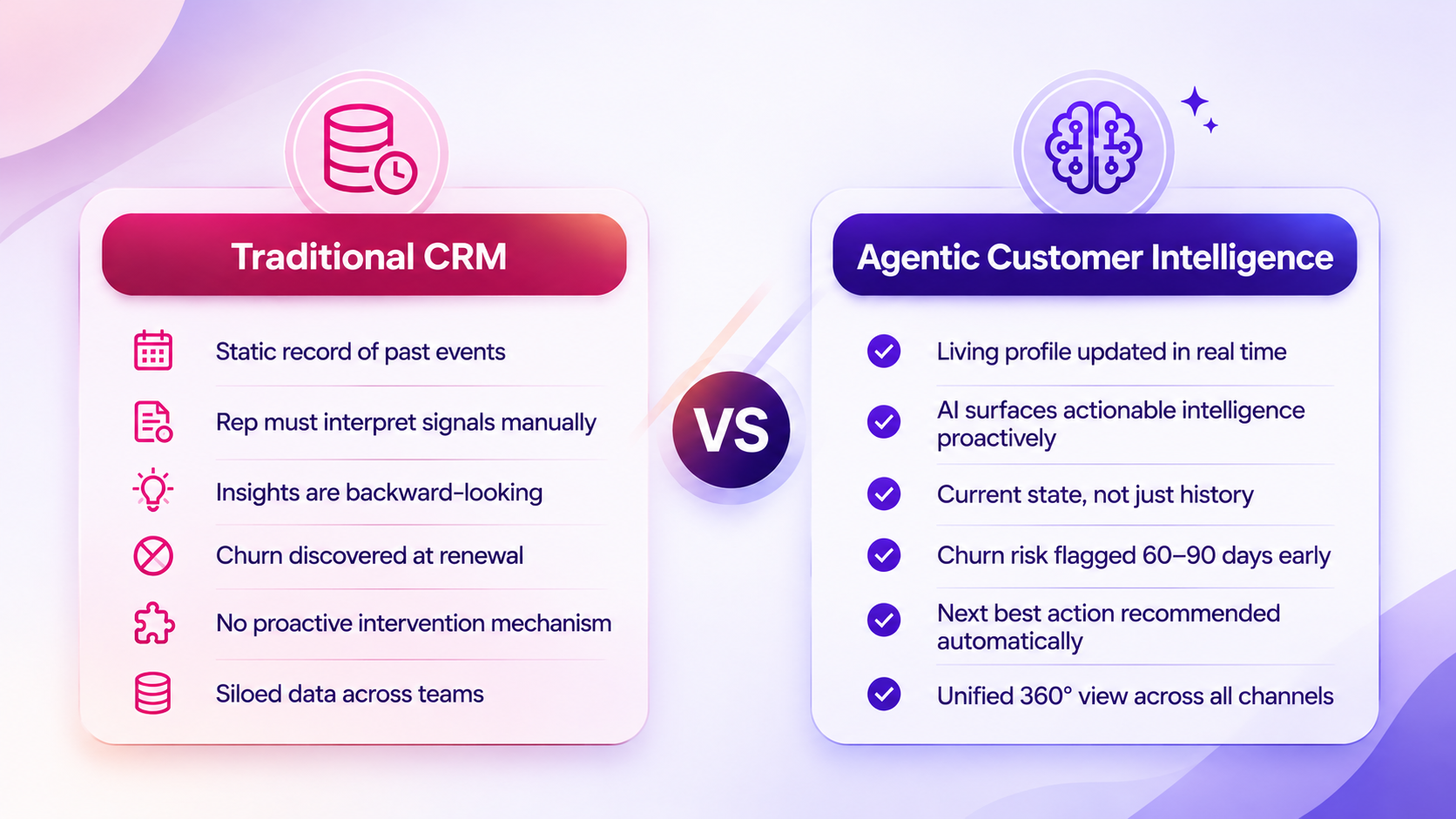
The agentic layer synthesizes these signals into a living profile updated in real time, surfacing the most actionable intelligence proactively. A sales manager opening a customer record doesn’t see history, they see current state: usage is down 30% over the past month, a competitor was mentioned in a recent support ticket, renewal is 60 days out, and the system has already recommended the most effective intervention with the rationale attached.
IBM’s analysis of AI in CRM identifies predictive analytics as the defining contribution; analyzing historical data and customer behavior to deliver unified intelligence for churn prediction, sales forecasting, and targeting, enabling smarter long-term decisions that no static CRM could generate.
The Churn Economics That Make This Urgent
The financial case for proactive customer intelligence is asymmetric. Retaining existing customers is consistently more cost-effective than acquiring new ones, making churn rate a key indicator of financial health and the signals that precede churn are almost always present in behavioral data before the customer has consciously decided to leave.
That is the critical point. Churn is not an event; it is a process. A customer who cancels in November typically began disengaging in August. The signals were there: the drop in login frequency, the unresolved support ticket, the feature they stopped using. In a traditional CRM environment, those signals exist in separate systems and are never connected. The renewal conversation in November is the organization’s first real indication that something was wrong, by which point the customer has often already decided.
A major US airline that deployed AI for predictive customer insights achieved a 210% improvement in targeting accuracy for at-risk customers, an 800% increase in satisfaction among those targeted, and a 59% reduction in churn intention. These are not marginal improvements, they are the result of behavioral signals that already existed, now synthesized into timely and targeted action rather than missed opportunity.
A Western European telecom operator that built granular AI-powered customer intelligence, using microsegment-level churn models to identify specific reasons different customer groups were considering leaving, tripled its customer value management revenue from around 2% to around 6% within two years. The intelligence required no new data. It required an architecture capable of synthesizing existing data into decisions that could actually be acted upon.
From Signal to Action: The Intelligence Multiplier
The value of living customer profiles is not simply knowing more, it is the compounding effect on every customer-facing interaction. When a sales rep enters a renewal conversation with a real-time synthesis of the customer’s behavioral trajectory, product engagement, and risk indicators, the conversation is fundamentally different. It is not a pitch based on last year’s purchase. It is an informed dialogue grounded in what the customer is experiencing right now.
McKinsey’s research on next-best-experience AI identifies the core mechanism: a decisioning engine that answers the question “what does this customer need most in this moment?” and delivers a personalized, contextually appropriate response, with the model improving with each interaction as new data feeds back into the system.
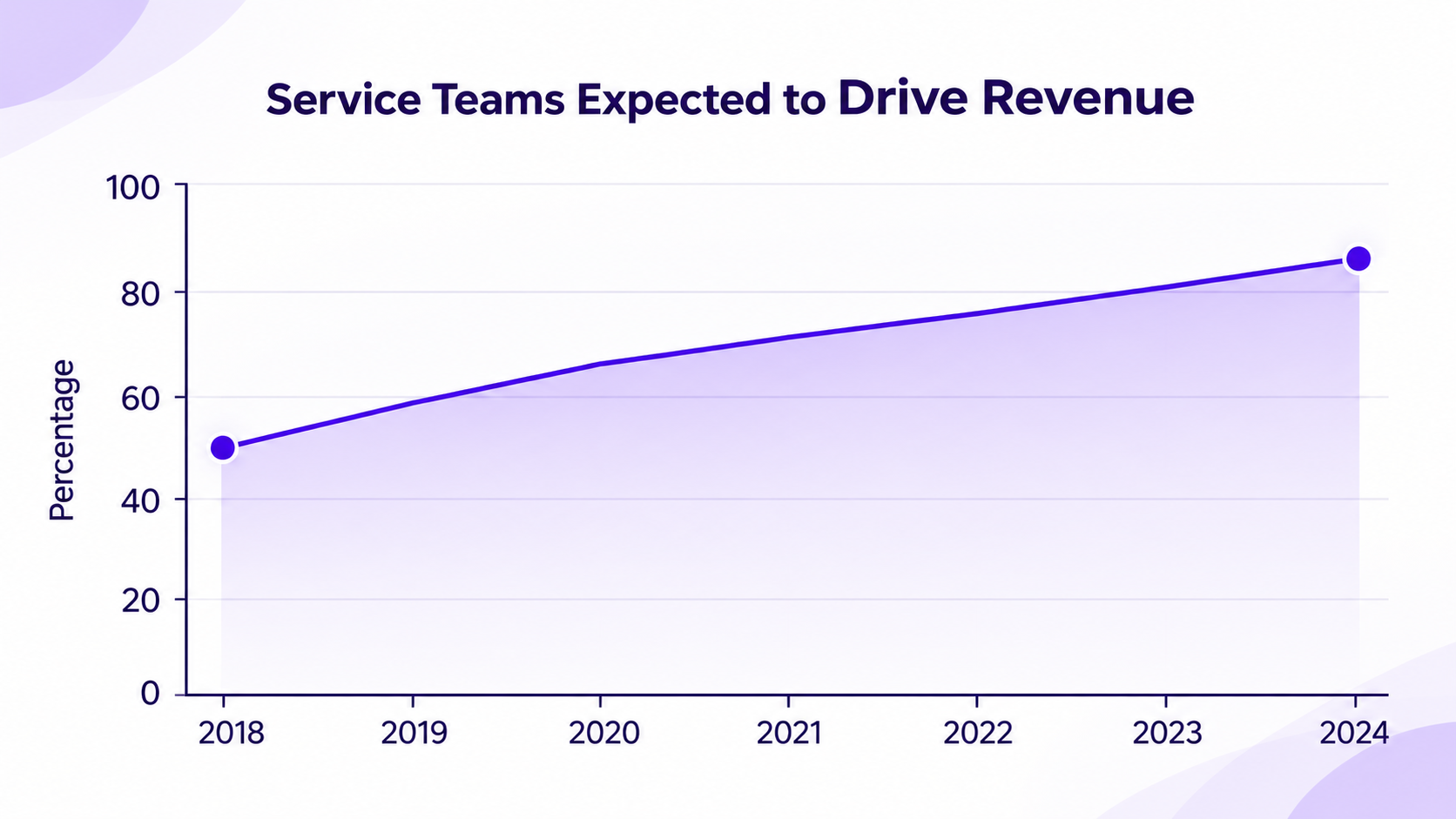
Salesforce’s 2024 research found that 85% of service decision-makers now expect their teams to contribute to revenue through upselling, cross-selling, and retention, up from 51% in 2018, with service budgets projected to grow by an average of 23% over the following year. That expectation cannot be met by teams working from static records and quarterly reviews. It requires intelligence that surfaces the right opportunity at the right moment, with the context needed to act on it effectively.
Salesforce’s AI CRM research captures the shift precisely: unlike a standard CRM which primarily stores and organizes data, an AI CRM uses that data to offer proactive recommendations and intelligent automations with agents that reach out to leads with personalized messages, optimize campaigns based on real-time signals, and respond to queries autonomously. The intelligence doesn’t just inform human action; it initiates it, at the scale and consistency no human team can match alone.
Privacy and Governance: The Non-Negotiable Foundation
Customer intelligence systems of this sophistication carry proportional responsibility. The same capabilities that make agentic CRM powerful; continuous monitoring, multi-signal synthesis, behavioral inference, create obligations that cannot be treated as afterthoughts.
Data governance must be foundational: clear policies on which signals are processed, how inferences are generated, who has access to AI-derived insights, and how long data is retained. Customer consent frameworks must be transparent; customers have a right to understand how their behavioral data influences interactions with the organization. Access controls must restrict AI-generated insights to teams with legitimate need and appropriate authority.
IBM’s guidance on AI in CRM is unambiguous: organizations must have data accuracy and privacy measures in place, because the entire foundation of customer relationships rests on security and trust. That trust is not separate from the intelligence system; it is the precondition for its value. An agentic architecture that erodes customer trust through opaque data practices destroys the relationship it was built to strengthen.
The Competitive Divide Is Opening Now
More than two in three workers, 68%, say generative AI will help them serve customers better, and 67% say it will help them get more value from existing technology investments, according to Salesforce’s ongoing research across more than 4,000 full-time workers.
McKinsey’s research on personalized marketing underscores the strategic opportunity: by applying AI to granular customer segmentation across lifecycle stages, acquisition, retention, repeat purchase, and churn risk, companies unlock additional margin while building behavioral intelligence that makes every subsequent intervention more precise and more effective.
The organizations making this shift are not simply improving CRM utilization. They are building a fundamentally different relationship with their customers; one grounded not in what happened last quarter, but in what is happening today. Every interaction sharpens the model. Every retained customer strengthens the intelligence that protects the next one. The competitive divide between organizations that build this capability now and those that wait is opening, and it will not be easy to close.