Agentic AI refers to autonomous AI systems that can independently pursue goals with minimal human oversight. Unlike traditional software or prompt-driven AI, agentic AI can proactively plan, reason, adapt, and take action to complete complex tasks.
These systems interact with other agents and external software to automate workflows while making context-aware decisions. They continuously learn from their environment, allowing them to handle dynamic situations more effectively. For example, an agentic AI system could automatically reorganize employee schedules when someone calls in sick while still meeting operational requirements.
Key Characteristics of Agentic AI
Proactive: Agentic AI anticipates issues and takes initiative rather than simply reacting to inputs. For example, in supply chains, it can predict delays and reroute shipments automatically.
Adaptable: These systems adjust to changing environments and use domain-specific knowledge to respond intelligently in real time.
Collaborative: Agentic AI works alongside humans and other AI agents, coordinating actions and aligning around shared goals.
Specialized: Many agentic systems consist of multiple specialized agents, each handling a focused task, such as fraud detection, compliance, or analytics, while collaborating to complete larger workflows.
Multi-Agent Collaboration
Multi-agent collaboration refers to the coordinated interaction of multiple independent agents within a distributed system, where each agent has its own local knowledge and decision-making ability. These agents communicate through defined protocols to share information, assign tasks, coordinate actions, and solve problems collectively. Cooperation may happen directly through messaging or indirectly through changes in a shared environment, allowing the system to function without centralized control while remaining scalable and fault tolerant.
A useful analogy is a fleet of drones searching a disaster zone. Each drone independently navigates the area, avoids collisions, reports findings, and adapts to unexpected situations and yet all drones work together toward a shared objective. In the same way, autonomous AI agents collaborate intelligently and in real time to solve complex problems faster and more efficiently.
This collaborative model is reshaping modern product architecture by enabling systems that can scale dynamically, adapt to changing demands, and continuously optimize themselves with minimal human intervention. Specialized AI agents work together to deliver end-to-end services across applications such as intelligent chatbots, where different agents handle tasks like retrieval, reasoning, and response generation in real time.
Why Do Agents Need to Collaborate
Multi-agent collaboration is a critical requirement when designing intelligent systems, particularly in environments that are complex, distributed, real-time, and privacy-sensitive. Compared to single-agent architectures, multi-agent systems (MAS) offer significant architectural, computational, and operational advantages. Traditional single-agent systems often face limitations such as:
Restricted scalability
- Higher latency in complex workflows
- Limited flexibility and functional specialization
- Dependence on centralized processing and decision-making
- Multi-agent systems address these challenges by enabling multiple autonomous agents to work together toward shared or interconnected goals. Each agent operates independently while also cooperating with other agents through communication protocols. This allows them to: Share partial knowledge about their environment, Coordinate decisions and actions in real time, Distribute workloads across the system, Maintain decentralized control strategies, Adapt dynamically to changing conditions
Because the architecture is modular, new agents or subsystems can be integrated seamlessly without disrupting the overall system.
How Multi-Agent Systems Work
Multi-agent systems operate through a coordinated process where independent AI agents communicate, assign responsibilities, and collaborate to solve complex problems efficiently. Each agent functions as an intelligent unit built around five core components:
Core Components of an AI Agent
Foundation Model (m): The agent’s reasoning engine, responsible for understanding and generating natural language.
Objective (o): The specific goal or task the agent is designed to accomplish.
Environment (e): The setting in which the agent operates, including other agents, APIs, tools, or shared memory systems.
Input Perception (x): Information the agent receives from its environment or from other agents.
Output / Action (y): The response or action produced based on the agent’s reasoning and objectives.
The Multi-Agent Collaboration Process
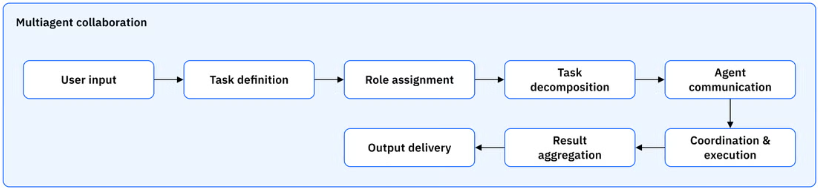
- Task Assignment: The system receives a request from a user or environment and determines which agents are required, along with the roles each will perform.
- Task Decomposition: Complex problems are broken down into smaller, manageable tasks using a planner or reasoning-capable language model.
- Communication & Coordination: Agents exchange information through shared memory, intermediate outputs, or structured communication channels to coordinate their work.
- Task Execution: Agents carry out assigned responsibilities either: Concurrently (in parallel), Sequentially (step-by-step), Dynamically (adjusting in real time)
- Result Aggregation: Outputs from different agents are combined into a unified response. An orchestrator or a final coordinating agent then delivers the final action or response to the user.
Research on human-AI teams shows that workplaces are rapidly evolving toward collaborative models where AI agents work alongside humans rather than replace them. A study involving 2,310 participants found significant productivity gains when AI agents were integrated into team workflows.
Key Findings:
- 60% increase in productivity compared to human-only teams
- 137% increase in communication and coordination within teams
- Workers spent 23% more time on strategic and creative tasks
- AI-assisted outputs required 84% fewer edits than human-only work
As AI agents handle repetitive and execution-heavy tasks, humans are increasingly focusing on:
- Strategy and oversight
- Creativity and decision-making
- Managing and coordinating AI systems
Broader Workforce Trends:
- 85% of organizations have already started integrating AI into operations
- Companies report an average 35% productivity boost from AI agents
- Demand for AI-related skills has increased 7x in two years
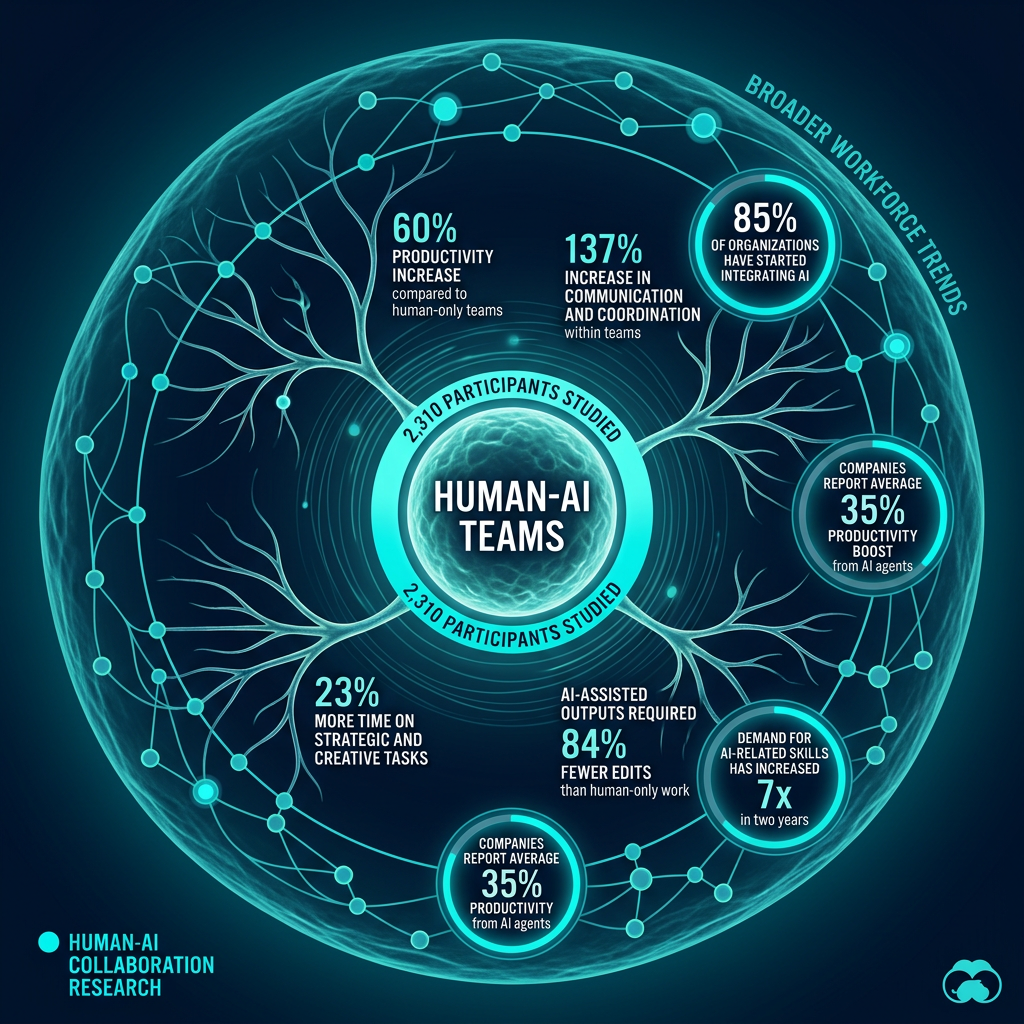
Overall, the research suggests the future workforce will center on human-AI collaboration, where AI delivers speed and automation while humans provide judgment, creativity, and strategic direction.