
Trust, Control, and Guardrails: The Ethics of Letting AI Agents Speak for Your Brand

Share

Key Takeaways

  • Every AI-generated interaction is effectively a brand decision, making governance and oversight critical to customer trust and reputation 
  • AI hallucinations caused an estimated $67.4 billion in business losses in 2024, highlighting the growing financial and operational risks of inaccurate AI outputs 
  • Common AI failure modes include fabricated statistics, nonexistent citations, incorrect product information, and brand/entity confusion 
  • Effective AI governance requires layered guardrails across three dimensions: technical controls, ethical oversight, and operational governance 
  • Human-in-the-loop approvals, grounded responses, auditability, and smart escalation paths are essential for reducing risk in high-impact workflows 
  • Organizations that continuously monitor, refine, and govern AI systems responsibly will gain a long-term trust advantage as autonomous AI adoption accelerates 

Introduction

Every time an AI agent sends an email, responds to a customer, publishes a statement, or takes action on behalf of an organization, it is making a brand decision. At scale, those decisions shape customer trust, regulatory exposure, operational risk, and public perception. 


The challenge is no longer whether AI systems can communicate effectively. Rather, it is whether organizations can trust them to do so responsibly. As agentic AI systems become increasingly autonomous, the risks associated with inaccurate messaging, compliance failures, tone misalignment, or unauthorized actions grow significantly. 


This creates a fundamental shift in enterprise responsibility. In traditional communication workflows, accountability is clear: humans review, approve, and own outcomes. In agentic systems, communication can occur autonomously across thousands or millions of interactions per day, creating new governance, oversight, and accountability challenges. 


The reality is that AI systems will make mistakes. The defining factor is not whether failures occur, but whether organizations have built the governance infrastructure to detect, contain, audit, and learn from them. By 2026, AI governance is rapidly emerging as a strategic priority across industries. Regulators, enterprise leaders, and security teams are increasingly focused on issues such as AI transparency, explainability, auditability, and operational control, especially in customer-facing systems where reputational damage can scale instantly. 

Why Agentic Communication Changes the Risk Model

For voice agents, safety is fundamentally about maintaining trust, protecting customers, and ensuring organizations retain control over how AI behaves. A reliable voice agent should: 


  • Rely on verified information instead of generating inaccurate or fabricated responses 
  • Operate within predefined rules and boundaries 
  • Recognize when a situation requires escalation to a human representative 
  • Maintain clear, auditable records of customer interactions 
  • Improve responsibly through continuous testing and feedback 


These expectations are similar to the standards applied to human support teams. However, AI systems operate at a much larger scale, making direct oversight more difficult than with human employees. Unsafe or poorly governed voice AI can create serious risks, including: 


  • Reputational damage caused by inappropriate or off-brand responses 
  • Reduced customer trust when incorrect information is provided 
  • Compliance issues from missing disclosures or generating unsupported answers 
  • Higher support costs when customers need follow-up assistance or corrections 
  • Slower internal adoption if teams lack confidence in the AI’s reliability and predictability 


Ultimately, safety in voice AI is not just a governance concern; it is a core product quality requirement and a necessary foundation for deploying AI voice agents in real-world customer environments. 

The 67 Billion Dollar Problem

AI hallucinations have become a major business risk, with reports estimating that inaccurate or fabricated AI-generated information caused businesses to lose $67.4 billion in 2024. These losses stem from wasted marketing spend, damaged brand reputation, lost customers, and the operational costs of correcting misinformation generated by AI systems. 


At the center of the issue is the phenomenon often described as a “confident misfire.” Large Language Models (LLMs) are designed to predict likely word sequences, not verify factual accuracy. As a result, they can present incorrect information in a highly convincing manner. In business environments, this creates serious consequences. For example, if an AI assistant incorrectly describes a company’s pricing, policies, or product capabilities, potential customers may abandon the brand before ever engaging directly with it. 


By 2026, AI has evolved from a supporting tool into a primary interface for search and discovery. Many users now rely on AI-generated summaries and synthesized answers instead of traditional search engine results. This shift significantly increases the impact of hallucinations, particularly in high-stakes industries such as healthcare and finance, where inaccurate guidance can lead to compliance failures, financial loss, safety risks, and severe reputational damage. As AI becomes more deeply embedded in customer interactions and decision-making, ensuring accuracy, transparency, and trustworthy outputs is becoming a critical business requirement rather than a technical preference.


Common Forms of Brand Hallucinations 


Fabricated Statistics: AI models may generate believable but entirely false data points or percentages to make responses appear more authoritative. 


Nonexistent Citations: Models sometimes reference studies, reports, authors, or institutions that do not actually exist, including fictional academic research or fake expert attributions. 


Brand & Entity Mix-Ups: AI can confuse companies with competitors, incorrectly attributing founders, headquarters, timelines, or company history. 


Invented Product Details: Systems may create nonexistent product features, service tiers, or pricing information, potentially misleading customers during purchasing decisions.


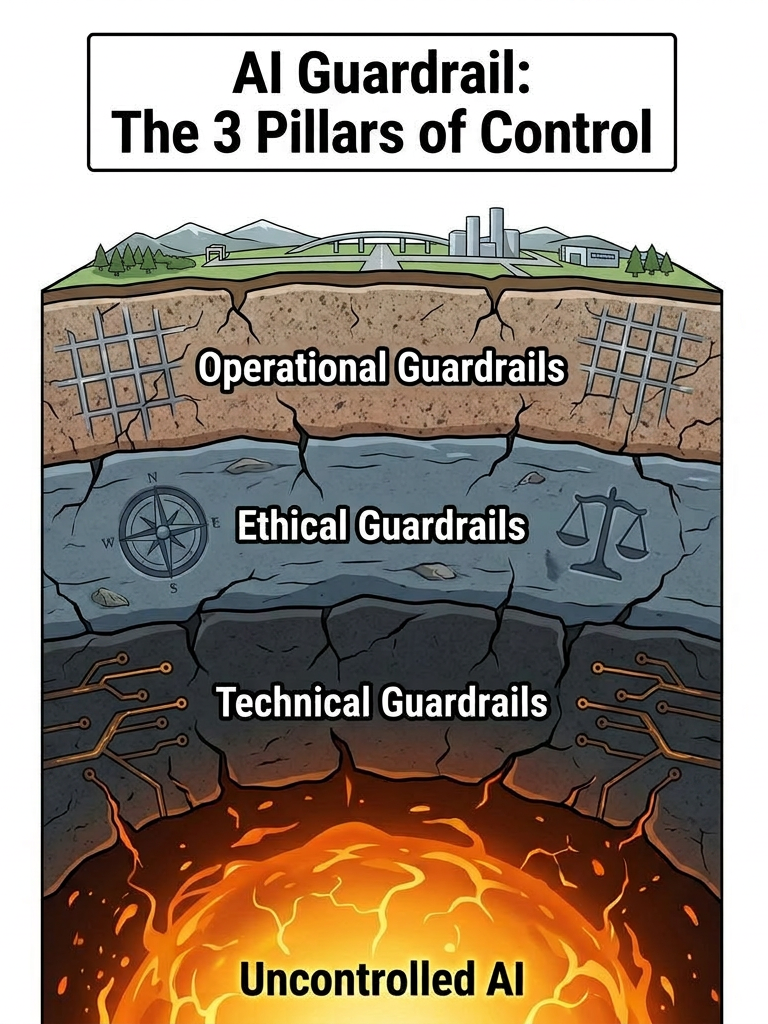
The 3 Pillars of Control

To deploy AI agents safely, organizations need a layered governance framework that combines technical, ethical, and operational controls.


Technical Guardrails


These controls define the system’s hard operational boundaries and reduce security or compliance risks. 


Human-in-the-Loop Approvals: High-risk or irreversible actions, such as refunds, subscription changes, or transactions, should require human authorization before execution.  


Input Validation & Output Filtering: Systems should sanitize prompts to prevent malicious attacks while filtering outputs to block harmful content, toxic language, or exposure of sensitive information like PII. 


Grounded Responses: To reduce hallucinations, AI agents should rely on verified internal data sources and trusted knowledge bases instead of depending solely on general model training. 


Ethical Guardrails


These safeguards help ensure fairness, accountability, and transparency in AI decision-making. 


Explainability: Organizations should be able to trace why an AI agent made a recommendation or took a specific action instead of relying on opaque “black box” behavior. 


Bias Monitoring: AI systems should be continuously audited to identify and reduce biased outputs or unfair decision patterns. 


Operational Guardrails


These controls align AI behavior with company policies, workflows, and brand standards.  


Clear Role Definitions: Agents should follow predefined rules for tone, behavior, and approved discussion topics, ensuring consistent and compliant interactions. 


Smart Escalation Paths: If the AI encounters customer frustration, uncertainty, missing information, or requests outside its authority, it should seamlessly transfer the interaction to a human representative. 

Best Practices and Challenges in AI Agent Governance

Common Challenges in Managing AI Agents 


Organizations face several challenges when governing AI agents in customer service environments: 


Consistency Issues: AI agents may produce inconsistent or inappropriate responses if training data contains gaps or biases. 


Privacy & Compliance Risks: Balancing personalized AI experiences with customer privacy and regulatory compliance remains complex. 


Rapid AI Evolution: Governance policies can quickly become outdated as AI capabilities and risks evolve. 


Legacy System Integration: Connecting AI agents with older enterprise systems may create deployment and monitoring difficulties. 


Alignment with Brand & Values: Ensuring AI behavior consistently reflects organizational standards and customer expectations requires continuous oversight. 


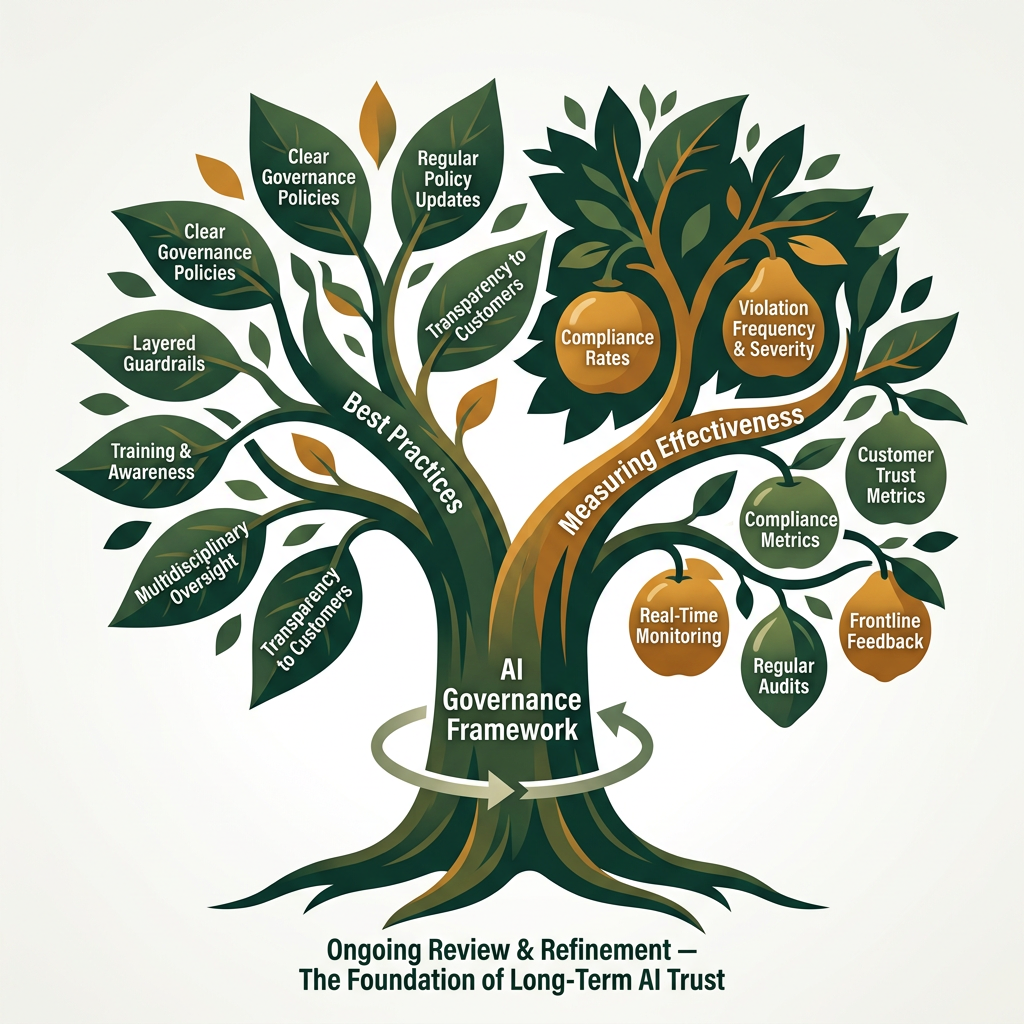
Best Practices for Strong AI Governance 


To maintain effective governance, organizations should adopt structured and continuously updated frameworks: 


  • Establish clear governance policies aligned with business values and regulations 
  • Regularly update policies to address evolving AI risks and technologies 
  • Implement layered technical, ethical, and operational guardrails 
  • Provide governance training and awareness programs for internal teams 
  • Use multidisciplinary oversight teams involving legal, technical, and customer service experts 
  • Maintain transparency by clearly disclosing AI involvement to customers when appropriate 
  • Measuring Governance Effectiveness 


Organizations should continuously evaluate governance frameworks using both operational and customer-focused metrics, including: 


  • Compliance rates with governance policies 
  • Frequency and severity of governance violations 
  • Customer satisfaction and trust metrics related to AI interactions 
  • Real-time monitoring for abnormal or non-compliant AI behavior 
  • Regular audits to identify risks, gaps, or policy failures 
  • Feedback from customers and frontline teams regarding AI performance and fairness 


Ongoing measurement and review help organizations refine governance strategies, improve AI reliability, and maintain long-term trust in AI-driven services. 

Conclusion

As AI agents increasingly communicate on behalf of organizations, governance is becoming just as important as model capability. The challenge is no longer whether AI can generate human-like responses, but whether those responses remain accurate, aligned, auditable, and trustworthy at enterprise scale. 


The risks are substantial. In 2024 alone, AI hallucinations were estimated to contribute to $67.4 billion in business losses, highlighting how inaccurate or fabricated outputs can quickly translate into reputational damage, customer churn, compliance failures, and operational disruption. As AI becomes a primary interface for customer interaction and information discovery, the cost of poorly governed systems will only grow. 


Organizations therefore need more than powerful models: they need layered governance frameworks built around technical safeguards, ethical oversight, and operational controls. Grounded responses, explainability, escalation mechanisms, audit trails, and human-in-the-loop approvals are no longer optional features; they are foundational requirements for deploying AI responsibly in customer-facing environments. 


At the same time, governance cannot remain static. AI systems evolve rapidly, and governance models must evolve with them through continuous monitoring, testing, policy refinement, and multidisciplinary oversight. The organizations that succeed will be the ones that treat AI governance not as a compliance exercise, but as a core capability tied directly to customer trust and brand integrity. 


To cap it off, trust in agentic AI is earned through reliability, transparency, accountability, and the ability to correct mistakes visibly and responsibly. In an era where AI increasingly speaks for the brand, governance becomes the mechanism that ensures the brand can still stand behind every interaction.

Explore More Articles

Join our 120k+ big community connect our newsletter

Email
Act Now!

Get Started For Free

No credit card Required. Access everything you need to get started for free, forever.

Koronik.AI is an agentic AI platform for deploying bespoke AI agents at scale. We automate communication, intelligence, and workflow to deliver measurable ROI.

Company

Address

Address: 1530 Wilson Blvd, Suite 650, Arlington VA 22209, USA

Subscribe

Email

© 2025 Graaho Technologies LLC.