

Agentic AI as Your Personal Chief of Staff: Automating Calendars, Briefings, and Follow-Ups

Share

Key Takeaways

  • Agentic AI is shifting productivity software from passive organization tools → proactive operational support systems that can coordinate, execute, and follow through autonomously. 
  • AI chief-of-staff systems can automate high-friction workflows such as scheduling, meeting preparation, action-item tracking, and follow-up management across enterprise platforms. 
  • Pre-meeting intelligence briefings and post-meeting execution are among the highest-value use cases, significantly reducing context switching and administrative overhead. 
  • Organizations deploying AI-driven scheduling and workflow automation are reporting measurable improvements in meeting efficiency, decision speed, and operational continuity. 
  • The value of agentic systems compounds over time as they learn organizational structures, communication patterns, user preferences, and workflow priorities. 
  • Strong governance remains essential. Privacy protection, approval controls, permission boundaries, and human oversight are critical to deploying AI chief-of-staff systems safely and reliably. 

Introduction

Modern knowledge work is increasingly defined by coordination overhead. Meetings, scheduling conflicts, follow-ups, email threads, status updates, and context switching consume a growing share of the workday, often leaving less time for strategic thinking and high-value execution. According to Microsoft’s Work Trend Index, employees spend nearly 57% of their time communicating, including email, meetings, and chat, while interruptions and context switching continue to erode productivity across organizations.


For executives and managers, the burden is even greater. Coordinating calendars across multiple stakeholders, preparing for meetings, reviewing prior conversations, tracking action items, and ensuring accountability across projects can consume hours every day. Traditionally, these responsibilities were handled by chiefs of staff, executive assistants, or operations teams. 


Agentic AI is beginning to replicate many of these functions autonomously. Unlike traditional productivity tools that simply organize information, agentic systems can proactively coordinate workflows, manage schedules, gather context, generate briefings, track commitments, and follow through on operational tasks with minimal human intervention. 


This marks a shift from passive productivity software → proactive operational support systems. Instead of helping users work faster, agentic AI increasingly acts as a digital chief of staff: maintaining awareness across conversations, calendars, projects, and priorities while ensuring that important details do not fall through the cracks. 


By 2026, enterprises are rapidly expanding adoption of AI-powered workplace automation. Organizations deploying agentic productivity systems are reporting measurable reductions in administrative workload, improved meeting efficiency, and greater operational continuity across distributed teams.

From Productivity Tools to Operational Intelligence Systems

Traditional productivity software operates reactively: 


  • Calendars display availability 
  • Email tools organize messages 
  • Project management systems track tasks 
  • Meeting tools record conversations 


Humans still remain responsible for coordinating everything manually. On the other hand, Agentic AI introduces a fundamentally different model. These systems can: 


  • Observe workflows continuously 
  • Understand context across systems 
  • Plan actions autonomously 
  • Execute operational tasks 
  • Learn organizational preferences over time 


The result is a persistent operational intelligence layer that reduces coordination friction across the organization.

How Agentic Chief-of-Staff Systems Work

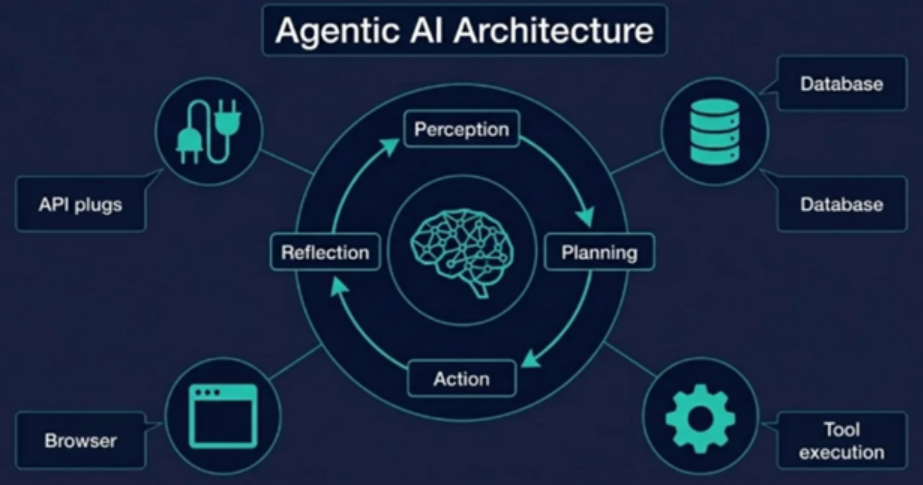
The 3 Core Capabilities 


Perception, Context Understanding, & Reasoning: The AI agent continuously gathers signals from connected systems like email threads, calendars, meeting platforms, CRMs, task management tools, messaging platforms, documents and notes. Modern systems integrate with platforms, such as Google Workspace, Microsoft 365, Salesforce, Zoom etc. This allows the system to maintain continuous situational awareness across workflows. Modern systems can process multiple forms of data at once, including emails, chat conversations, voice interactions to understand intent, context, and patterns more accurately. For example, before a sales meeting, the system may automatically identify: recent customer communications, open support tickets, etc. This transforms fragmented information into actionable operational context. 


Autonomous Decision-Making: After understanding the situation, the agent determines the most effective course of action. In supply chain management, for example, an AI agent can continuously assess warehouse inventory, supplier delays, shipping costs, and customer demand to automatically adjust procurement and distribution strategies in real time, reducing shortages and operational disruptions. 


Proactive Task Execution and System Integration: What truly differentiates AI agents from traditional tools is their ability to take action independently rather than simply provide recommendations. For instance, in IT operations, an AI agent can detect unusual server activity, create incident tickets, restart affected services, notify the appropriate teams, and document the resolution process automatically, helping reduce downtime and manual intervention.
 

Calendar Automation: Eliminating Scheduling Friction

Calendar coordination remains one of the largest hidden productivity drains inside organizations. Scheduling a meeting often involves: 


  • Multiple email exchanges 
  • Time-zone coordination 
  • Rescheduling conflicts 
  • Availability negotiations 
  • Reminder management 


Agentic scheduling systems eliminate most of this overhead. These systems can:


  • Access participant availability 
  • Prioritize scheduling preferences 
  • Negotiate alternate times automatically 
  • Detect conflicts dynamically 
  • Reschedule meetings proactively 
  • Send reminders and updates 


The human role shifts from managing logistics to approving outcomes. 

Pre-Meeting Intelligence Briefings

Common Challenges in Managing AI Agents 


One of the highest-value applications of agentic AI is automated executive briefing generation. Before a meeting, the system can autonomously compile:


  • Recent email exchanges 
  • CRM updates 
  • Open action items 
  • Project milestones 
  • Customer sentiment signals 
  • Financial or operational metrics 
  • Relevant documents and notes 


The result is a concise intelligence briefing delivered minutes before the meeting begins which reduces: 


  • Context switching 
  • Manual preparation time 
  • Information fragmentation 


As a result, executives can enter meetings fully informed without spending hours gathering context manually. 

 

Post-Meeting Execution & Follow-Through

Meeting follow-through is another major operational bottleneck. Traditional workflows require humans to: 


  • Take notes 
  • Summarize decisions 
  • Identify action items 
  • Assign responsibilities 
  • Send recap emails 
  • Update project systems 


Agentic AI automates this process end-to-end. Post-meeting systems can: 


  • Transcribe conversations 
  • Extract key decisions 
  • Identify tasks and deadlines 
  • Assign owners automatically 
  • Update project management platforms 
  • Schedule follow-ups 
  • Track unresolved commitments

Quantifying the Impact

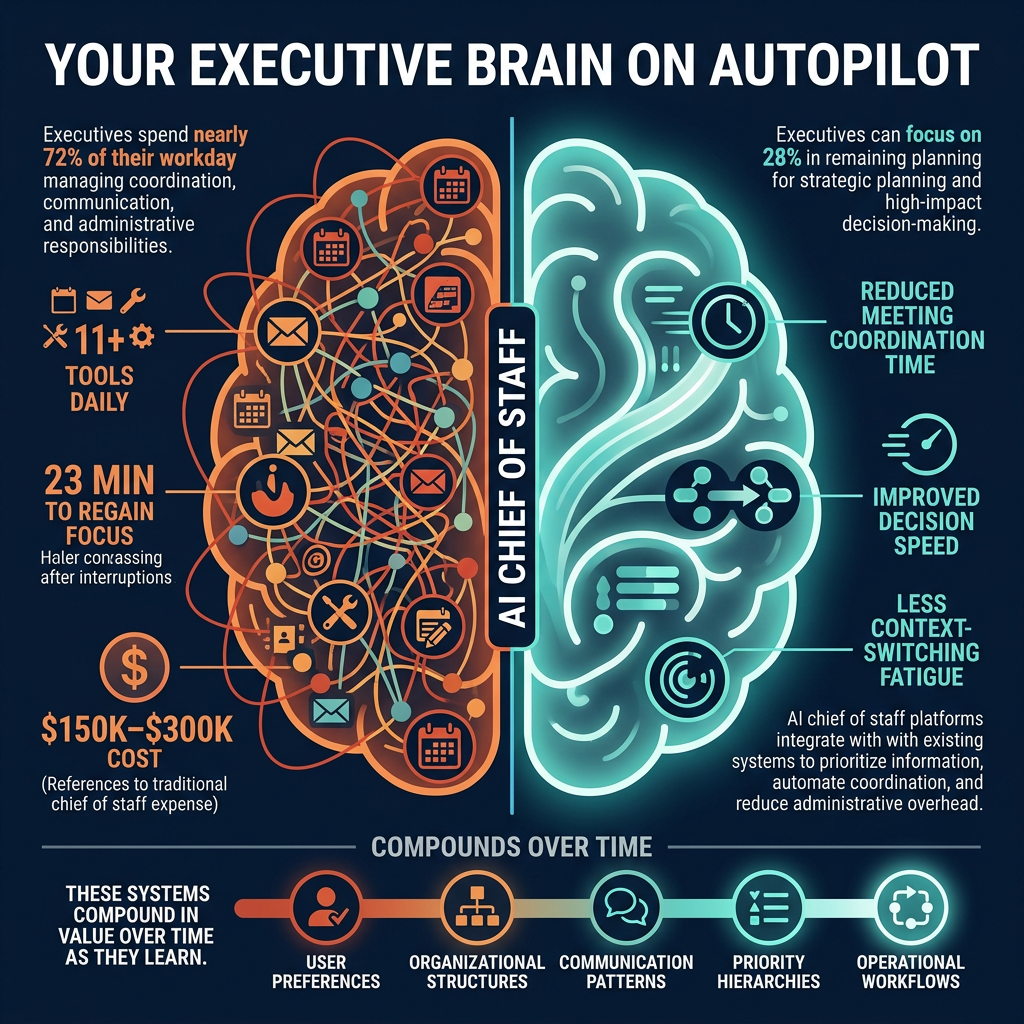
According to Harvard Business Review, executives spend nearly 72% of their workday managing coordination, communication, and administrative responsibilities, leaving only 28% for strategic planning and high-impact decision-making. Traditionally, a chief of staff helps rebalance this workload, but hiring one can cost between $150K and $300K annually, making it impractical for many organizations. Additional workplace data highlights the challenge: 


  • Executives lose significant productivity due to constant context switching, requiring an average of 23 minutes to regain focus 
  • Leaders typically manage more than 11 different tools every day 
  • Most executive time is consumed by operational coordination rather than strategic execution 


AI chief of staff platforms address this by integrating with calendars, email, meetings, and task management systems to prioritize critical information, automate coordination, and reduce administrative overhead. Research and enterprise benchmarks indicate: 


  • Organizations using AI scheduling and workflow automation report significant reductions in meeting coordination time 
  • AI-assisted meeting summaries and follow-ups reduce note-taking overhead while improving action tracking consistency 
  • Executives using AI briefing systems report improved decision speed and reduced context-switching fatigue 


More importantly, these systems compound in value over time as they learn: 


  • User preferences 
  • Organizational structures 
  • Communication patterns 
  • Priority hierarchies 
  • Operational workflows 


Unlike static automation tools, agentic systems improve through continuous interaction.
 

Risks & Operational Challenges

While Agentic AI can dramatically improve executive productivity, delegating scheduling, communication, and coordination tasks to autonomous systems introduces important operational, security, and governance risks. 


Privacy, Security, and Compliance Risks


Sensitive Data Exposure: AI chief-of-staff systems require access to confidential information such as emails, meeting transcripts, and financial data.  


Confidentiality Concerns: AI-generated summaries, follow-ups, or briefings could unintentionally share sensitive business information with the wrong recipients. 


Regulatory Compliance Risks: Automated handling of personal or financial data can create compliance issues with regulations. 


Context Limitations and AI Errors


Difficulty Understanding Nuance: AI agents may misinterpret workplace dynamics, urgency, or emotional context, resulting in poorly timed messages or scheduling decisions. Further, AI-generated briefings that rely on unreliable or incomplete sources may lead to poor executive decisions.


Hallucinated Decisions or Actions: Autonomous systems can occasionally generate incorrect assumptions, inaccurate summaries, or unauthorized actions based on incomplete context. When AI systems make mistakes, tracing the exact reasoning or workflow behind the error can be difficult. 


Integration Failures: Sync issues between AI systems and tools like calendars or communication platforms may lead to scheduling conflicts, missed meetings, or operational disruptions. 


Reduced Human Connection


Impersonal Communication: Over-automating executive communication can make interactions feel generic or transactional, weakening professional relationships. 


Automation Bias: Teams may begin approving AI-generated emails, schedules, or reports without proper review, increasing the likelihood of unnoticed errors. 

Best Practices for Safer Deployment

Organizations can reduce these risks by implementing strong governance and oversight measures: 


  • Require human approval before sending external communications or making major scheduling changes 
  • Deploy AI agents within secure enterprise ecosystems that protect proprietary data 
  • Establish strict operational guardrails and permission boundaries 
  • Limit access to sensitive systems, documents, and executive workflows 
  • Continuously monitor AI behavior, outputs, and integrations for reliability and compliance 


The most effective AI chief-of-staff systems are not fully autonomous replacements for human judgment, they function best as tightly governed executive support layers that enhance productivity while keeping humans in control. 

Conclusion

Agentic AI is redefining workplace productivity by transforming coordination itself into an automated, intelligent process. From scheduling meetings and generating executive briefings to tracking follow-ups and maintaining operational continuity, these systems reduce the administrative burden that traditionally consumes a large share of modern work. The greatest value is not simply time savings, but the ability to reclaim focus for strategic thinking, decision-making, and relationship management. However, successful deployment depends on strong governance, secure integrations, and clear boundaries around autonomy. The organizations that benefit most will be those that treat agentic AI not as a replacement for human judgment, but as a scalable operational support layer that enhances human effectiveness while keeping people firmly in control. 

Explore More Articles

Join our 120k+ big community connect our newsletter

Email
Act Now!

Get Started For Free

No credit card Required. Access everything you need to get started for free, forever.

Koronik.AI is an agentic AI platform for deploying bespoke AI agents at scale. We automate communication, intelligence, and workflow to deliver measurable ROI.

Company

Address

Address: 1530 Wilson Blvd, Suite 650, Arlington VA 22209, USA

Subscribe

Email

© 2025 Graaho Technologies LLC.