Agentic AI for Customer Support: The End of the Ticket Queue

Share

Key Takeaways

  • Agentic AI goes beyond chatbots by autonomously understanding, reasoning, and executing customer support actions in real time 
  • Organizations are achieving 60-80% autonomous resolution rates for routine support cases, significantly reducing queues and wait times 
  • Industries adopting agentic self-service are reporting 30-45% productivity gains, lower operational costs, and improved customer satisfaction 
  • The highest-value use cases involve repetitive, rules-based workflows such as password resets, refunds, account updates, and order management 
  • Human oversight remains critical for sensitive, high-risk, or emotionally complex interactions requiring empathy and judgment 
  • Successful deployments depend on strong governance, clear escalation paths, secure system access, and balanced human-AI collaboration 

Introduction

Customer support has traditionally operated as a system of controlled backlog: customers wait in queues, agents triage requests manually, and resolution speed depends largely on staffing capacity. Even with modern help desk software and chatbots, most organizations still rely heavily on human agents to interpret requests, gather context, and execute actions across disconnected systems.



The result is a model built around delay. Customers submit tickets, wait for routing, wait for responses, and often repeat information multiple times before resolution. For support teams, the reality is equally frustrating: high ticket volumes, repetitive workflows, burnout, and constant pressure to reduce response times while maintaining customer satisfaction. According to Gartner, traditional self-service portals successfully resolve only around 14% of customer issues, leaving the remaining 86% to result in friction, frustration, and increased support calls. 


Agentic AI is changing this model fundamentally. Rather than simply answering questions, modern AI agents can understand context, access enterprise systems, make decisions within defined policies, execute actions autonomously, and resolve issues in real time. This marks a transition from support as queue management → support as continuous resolution. The shift is already measurable. By 2026, enterprises deploying agentic support systems are reporting autonomous resolution rates of 60–80% for tier-one support cases, while AI-driven service operations are reducing handling times dramatically across customer support environments.  

From Chatbots to Autonomous Resolution Systems

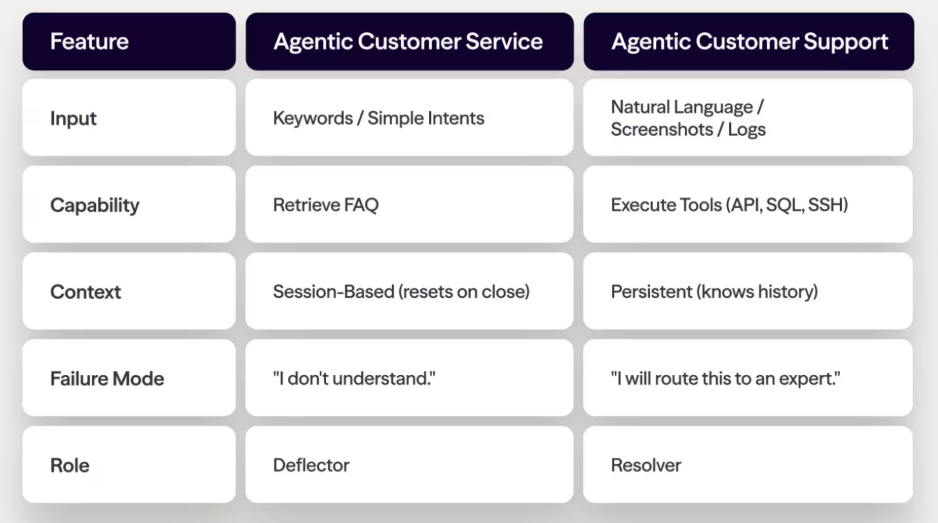
Traditional chatbots were designed around scripted interactions and decision trees. While useful for FAQs or simple routing, they struggle when conversations require: 


  • Context retention 
  • Multi-step reasoning 
  • Access to external systems 
  • Adaptive decision-making 


As a result, most chatbot interactions eventually escalate to humans. Agentic support systems operate differently. They combine reasoning, memory, orchestration, and execution capabilities to resolve issues end-to-end with minimal human involvement.


How Agentic Support Systems Work

Agentic AI self-service operates through four connected capabilities: perception, reasoning, action, and learning. Together, these components allow AI systems to understand customer intent, make decisions, execute tasks, and continuously improve over time. Modern implementations also depend on seamless integration with enterprise systems, APIs, and automation tools to ensure scalability, security, and compliance. 



Perception & Context Awareness: The perception layer interprets customer language through voice or text and gathers context from sources such as CRM systems, billing records, interaction history, and behavioral data. Instead of reacting to keywords alone, the AI combines multiple signals to understand intent more accurately and deliver context-aware responses. 


Reasoning & Multi-Step Planning: Unlike traditional conversational AI that simply generates answers, agentic AI breaks requests into structured workflows. It verifies identity, evaluates policies, checks eligibility, determines required actions, and plans execution steps in real time. 


Action & System Execution: Agentic AI connects directly to enterprise systems, such as CRMs, billing platforms, payment gateways, and knowledge bases, through APIs or automation layers to perform real actions rather than just generate text. 


Memory & Continuous Learning: Effective self-service depends on both short-term and long-term memory. Short-term memory prevents customers from repeating information during a session, while long-term memory enables personalized experiences based on past interactions and preferences.

Real-World Applications of Agentic Self-Service

Agentic self-service delivers the greatest value in industries where repetitive, rules-driven requests overwhelm support teams and frustrate customers. Rather than simply automating FAQs, these systems handle complete customer workflows autonomously from request to resolution. 


Banking & Financial Services

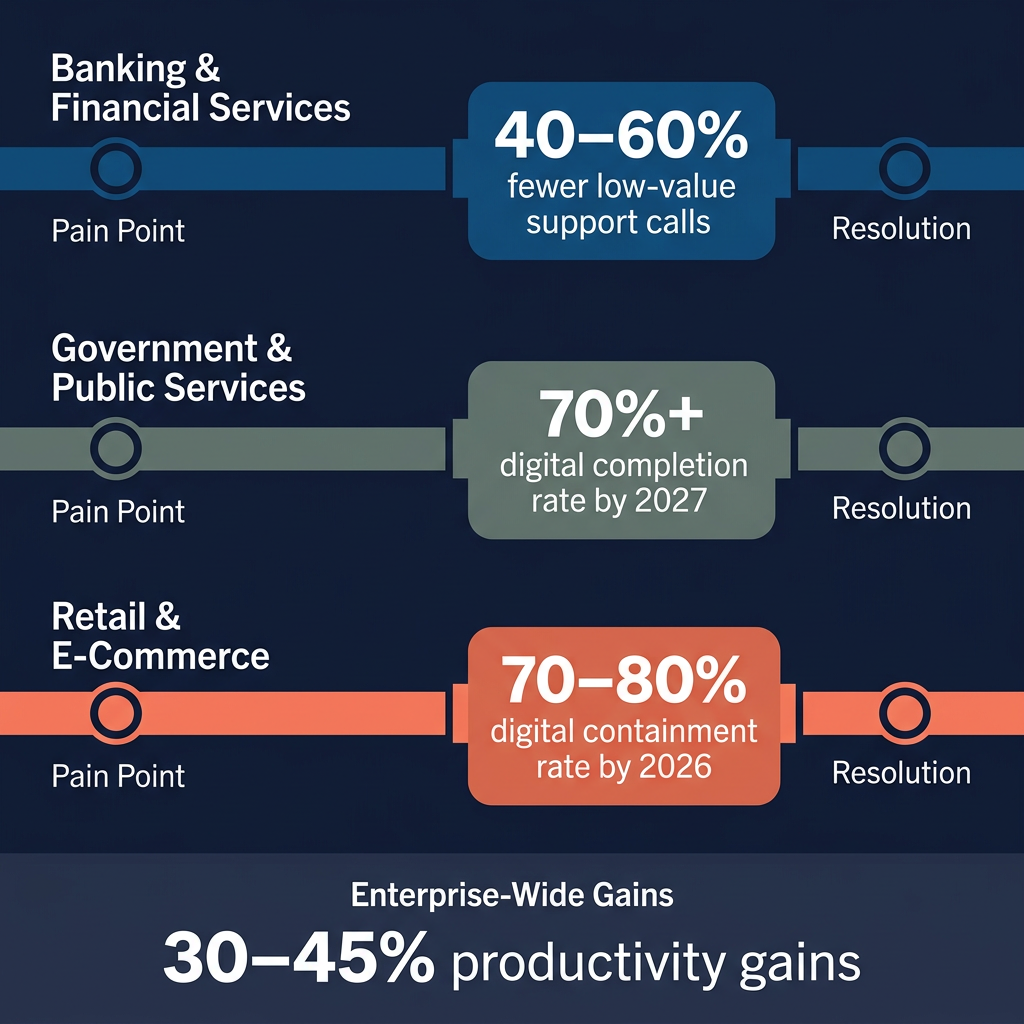
Agentic AI is transforming digital banking through automated card management and loan servicing. Customers can freeze cards, adjust spending limits, report fraud, or request replacements in a single interaction with built-in identity verification and compliance checks. Loan workflows are also becoming more autonomous, with AI systems pre-qualifying applicants, collecting documents, and accelerating approvals from days to minutes. Common outcomes include: 


  • 40-60% fewer low-value support calls 
  • Higher customer satisfaction and NPS scores 
  • Faster handling of routine service requests 


Government & Public Services

In the public sector, agentic AI streamlines citizen services such as permits, benefits, and records management. Systems can pre-fill forms using existing records, verify eligibility automatically, and schedule appointments while maintaining audit trails and policy compliance. Many governments aim to achieve 70%+ digital completion rates for routine services by 2027, reducing backlogs and improving consistency. 


Retail & E-Commerce 

Retailers are using agentic AI to automate post-purchase support, including shipment tracking, delivery updates, returns, and refunds. AI systems can validate policies, generate return labels, update inventory systems, and process credits without human involvement. By 2026, leading retailers are expected to achieve 70–80% digital containment rates for post-purchase inquiries, far beyond the capabilities of traditional chatbots. 


Enterprise-Wide Benefits 

Agentic self-service improves outcomes across the organization: 


  • Customers: Faster resolutions and reduced effort 
  • Support Teams: Less time spent on repetitive tasks 
  • Businesses: Lower operational costs and improved efficiency 


Research indicates that combining generative and agentic AI in customer care can drive 30-45% productivity gains, while also improving service profitability and long-term customer value.

 

The Critical Challenge: Governance & Scope Control

The success of agentic support systems depends heavily on defining autonomy boundaries. Low-risk actions suitable for automation: 


  • Password resets 
  • Order updates 
  • Shipping changes 
  • Refunds below policy thresholds 


These are repetitive, high-volume, low-risk workflows. Further, high-Risk actions requiring human oversight: 


  • Legal disputes 
  • Escalated complaints 
  • Sensitive customer relationships 
  • Large financial adjustments 


Human judgment remains essential for ambiguity, empathy, and risk management.

Risks & Failure Modes

Despite rapid progress, agentic support systems still face important limitations: 


Context Misinterpretation: AI may misunderstand: 


  • Sarcasm 
  • Emotional nuance 
  • Complex customer intent 


Over-Automation: Granting unrestricted execution authority too early can amplify operational mistakes. 


Hallucinations & Incorrect Actions: Without grounding and validation mechanisms, agents may produce inaccurate responses or trigger incorrect workflows. 


Security & Permissions: Because agents interact with enterprise systems directly, strict access controls and auditability are essential. 

Preserving Human Support and Escalation Pathways

Customers should always be able to reach a human representative easily, particularly for sensitive situations involving fraud, financial difficulties, healthcare, or legal matters. When AI becomes an obstacle instead of a support tool, customer trust quickly declines. Human-in-the-loop approaches help maintain the right balance between automation and oversight: 


  • AI can recommend actions while humans review exceptional or sensitive cases 
  • Systems can automatically escalate interactions when confidence levels are low 
  • Customers should have the option to request human assistance at any stage 


Organizations should also continuously monitor customer sentiment to ensure automation improves efficiency without reducing empathy or trust. Successful agentic AI deployments should enhance customer satisfaction, not compromise it.

The Future of Self-Service with Agentic AI

Agentic AI is reshaping self-service from simple information delivery into autonomous, end-to-end problem resolution. This shift reduces customer effort, lowers operational costs, and gives service teams more capacity to focus on higher-value work. 


The future of customer experience is not about replacing humans with AI, it’s about using AI to handle predictable, repetitive workflows while enabling human teams to focus on complex interactions, relationship-building, and strategic problem-solving. Tasks such as account updates, payment arrangements, and routine service requests can increasingly be managed autonomously across digital channels. 


By 2028, most high-volume, rules-based customer journeys are expected to be managed by autonomous AI agents across web, mobile, and voice platforms. Organizations investing early in strong data foundations, governance frameworks, and balanced human-AI collaboration will be best positioned to deliver seamless customer experiences. 


The most effective approach is to begin with a few focused use cases, align operational and compliance stakeholders early, and prioritize trust, continuity, and measurable business value from the start. Ultimately, success in the agentic AI era will come from creating experiences so smooth and efficient that customers simply notice that everything works, without needing to think about the AI behind it.

Conclusion

Agentic AI is transforming customer support from a reactive, queue-driven function into an intelligent, always-on resolution system. Instead of simply answering questions, modern AI agents can understand context, access enterprise systems, execute actions, and resolve routine issues autonomously in real time. 


The impact is already measurable. Organizations are achieving 60–80% autonomous resolution rates for tier-one support requests, while industries adopting agentic self-service are seeing 30–45% productivity gains, faster response times, lower operational costs, and improved customer satisfaction. As these systems mature, high-volume support workflows such as account updates, refunds, scheduling, and routine service requests will increasingly be resolved without human intervention. 


However, the long-term success of agentic support depends on balance. Strong governance, clear autonomy boundaries, human escalation pathways, and continuous monitoring are essential to ensure that automation improves efficiency without compromising trust, empathy, or accuracy. 


The future of customer experience is not about replacing human support teams — it is about enabling AI to handle repetitive, predictable workflows while humans focus on complex situations, relationships, and strategic problem-solving. Ultimately, the most successful organizations will be the ones that make support feel effortless: where customers simply get what they need quickly, accurately, and seamlessly, without ever having to think about the systems operating behind the scenes. 

Explore More Articles

Join our 120k+ big community connect our newsletter

Email
Act Now!

Get Started For Free

No credit card Required. Access everything you need to get started for free, forever.

Koronik.AI is an agentic AI platform for deploying bespoke AI agents at scale. We automate communication, intelligence, and workflow to deliver measurable ROI.

Company

Address

Address: 1530 Wilson Blvd, Suite 650, Arlington VA 22209, USA

Subscribe

Email

© 2025 Graaho Technologies LLC.