
Key Takeaways
- Manual data entry carries a 1–4% error rate that compounds across 20+ fields per record, driving $3.1 trillion in annual US economic losses from poor data quality, regulatory fines, and cascading downstream failures.
- End-to-end agentic pipelines cover ingestion, extraction, validation, and system entry without human keystrokes and critically, they flag errors before they enter the system rather than after they cause damage.
- The financial case is unambiguous: invoice processing costs drop 80%+, cycle times fall from 10.9 days to 3.1 days, and on-time payment rates improve from 70% to 95%, reducing vendor disputes by 40–60%.
- Full auditability, timestamped, immutable records of every document’s journey, is increasingly a compliance requirement, and it is a native output of agentic pipelines that manual systems cannot replicate.
- Human roles don’t disappear, they upgrade. Staff shift from transcription to exception management, rule refinement, and strategic analysis: work that is more skilled, more impactful, and demonstrably more satisfying.
- Manual data entry carries a 1–4% error rate that compounds across 20+ fields per record, driving $3.1 trillion in annual US economic losses from poor data quality, regulatory fines, and cascading downstream failures.
The Most Expensive Thing Your Team Does Every Day
Manual data entry doesn’t look expensive. It looks like someone at a keyboard, doing their job. That invisibility is precisely what makes it one of the most insidious drains in modern business operations; a cost that compounds silently, hides inside salary lines, and only surfaces when something goes wrong.
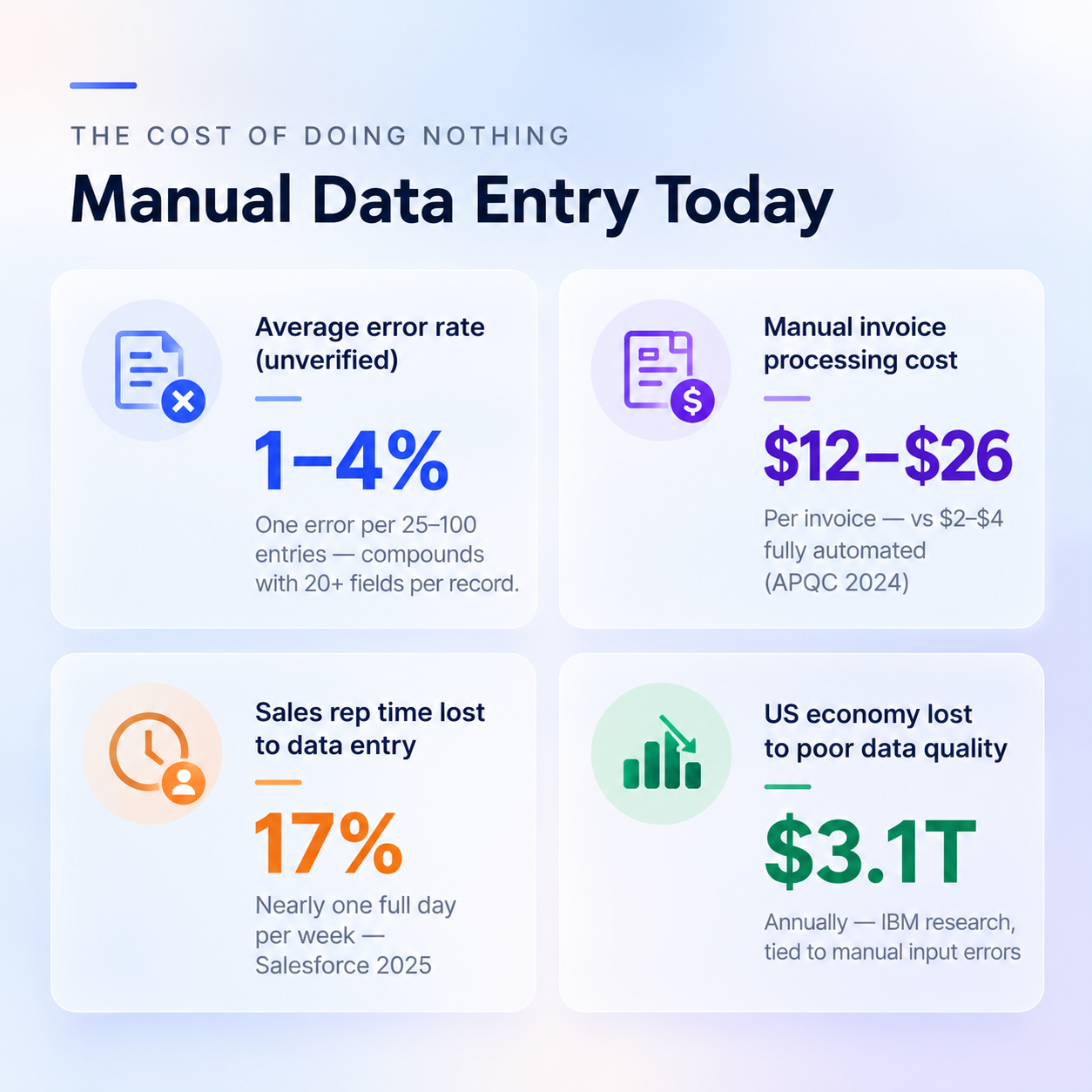
The average sales representative spends 17% of their working hours, nearly a full day per week, manually entering data into systems. Between 60% and 73% of all enterprise data goes unused for analytics; not because organizations don’t want insights, but because the data never made it cleanly into the systems that could generate them.
IBM research reveals that US businesses lose $3.1 trillion annually due to poor data quality, and at the root of much of that loss is an entirely preventable act: a human being, transcribing information from one place to another, introducing error at every keystroke.
The tragedy is not that data entry is hard. It’s that it is unnecessary. Agentic AI is enabling end-to-end document automation pipelines that handle the full journey from document receipt to system entry without a single human keystroke, and doing it faster, more accurately, and at a fraction of the cost.
The Error Is Already in the System — You Just Can’t See It
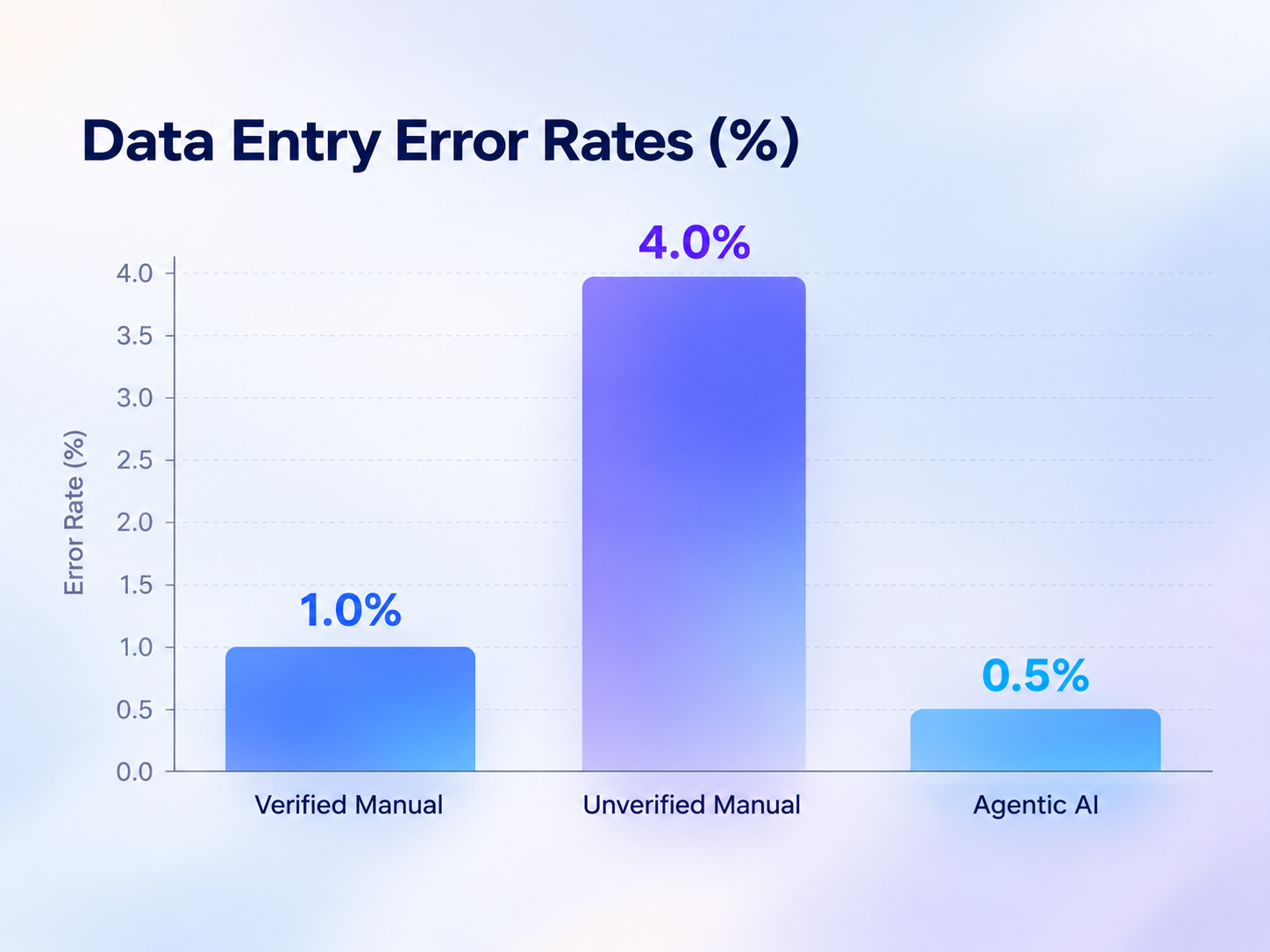
Before understanding what automation delivers, it’s worth confronting what manual entry actually costs. The accepted benchmark is a 1% error rate under normal, careful conditions. Without verification, that climbs to 4%. With 20 or more fields per record, errors compound; roughly every fifth record contains at least one mistake.
In most organizations, those mistakes don’t announce themselves. They enter the system quietly, get reported on, get acted upon, and create downstream consequences; a supplier paid the wrong amount, a compliance form with a transposed figure, a customer record with a wrong contact detail that generates months of failed outreach. Financial services AML and KYC violations resulted in $263 million in fines in 2024 alone, a 31% increase, directly tied to data inaccuracies. In healthcare, claim denials tied to data errors cost hospitals approximately $20 billion annually
These are not abstract risks. They are line items on quarterly earnings calls that trace back to someone entering the wrong number into the wrong field at the wrong time.
CRM databases degrade at a rate of 30% per year and manual entry accelerates this decay because humans skip optional fields, abbreviate inconsistently, and create duplicate records at a rate of 10–25% of total entries. The data an organization relies on to run its business is quietly rotting and the rot begins at the point of entry.
The Pipeline That Changes Everything
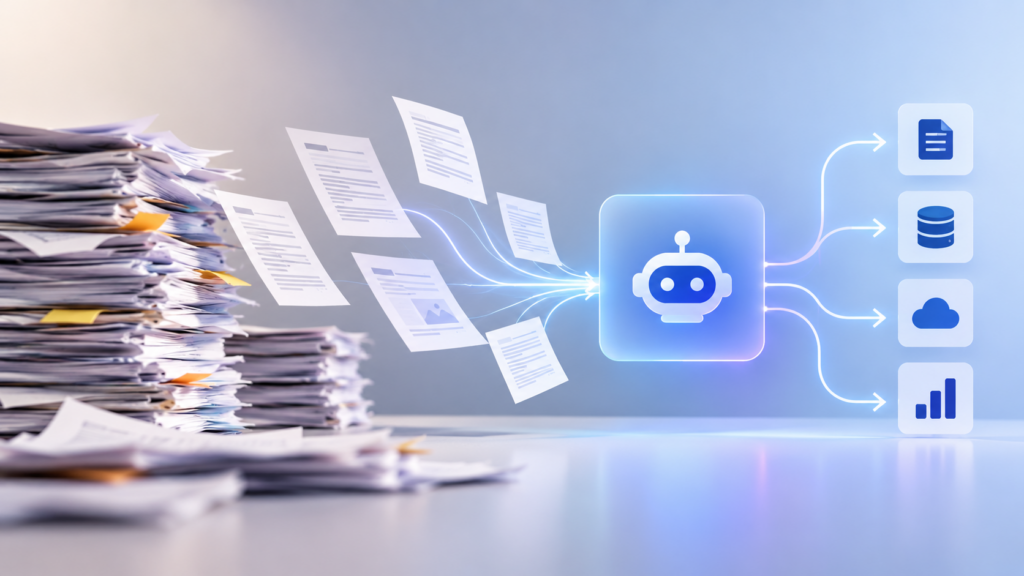
An agentic document automation pipeline is not a faster version of manual entry. It is a fundamentally different architecture; one that eliminates the transcription step entirely and replaces it with a continuous, intelligent flow from document receipt to system record.
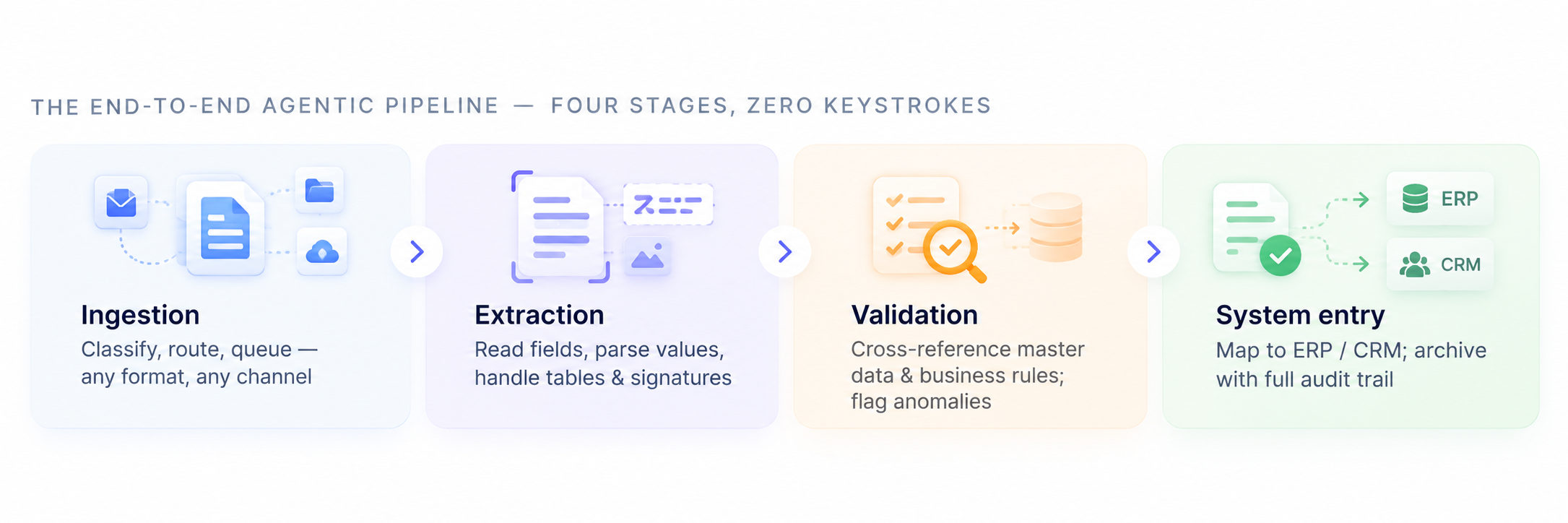
The pipeline begins at Ingestion. Documents arrive through every channel organizations actually use email attachments, portal uploads, fax conversions, scanned paper forms, EDI feeds, in formats ranging from structured XML to handwritten notes on a crumpled page. An agentic ingestion layer classifies each document by type, routes it to the appropriate processing workflow, and queues it for extraction. No human sorting. No intake queue. No documents sitting in an email inbox waiting for someone to notice them.
Extraction follows. This is where the semantic intelligence of modern agentic systems earns its value, identifying relevant fields across documents that look nothing alike, parsing values from multi-page documents, managing tables, checkboxes, handwriting, and signatures. Unlike template-based OCR that breaks when a vendor changes their invoice layout, agentic extraction understands what it’s looking for, not just where it usually appears.
Validation is where agentic IDP diverges most sharply from every prior generation of document processing. Rather than accepting extracted values at face value, the system cross-references them against master data, business rules, and prior documents in the same workflow, checking that quantities match purchase orders, that vendor IDs exist in the ERP, that dates fall within contract periods, that amounts don’t exceed approved thresholds. Anomalies surface for human review. Clean documents proceed automatically. The critical distinction: errors are flagged before they enter the system, not discovered after they’ve caused damage.
System entry is the final step, and with modern ERP and CRM integrations, it is fully automated. Extracted, validated data maps to the appropriate fields in the target system, the document archives with full metadata and audit trail, and the workflow closes. No keystroke touched it.
The Numbers That Make the Business Case Write Itself
The ROI case for agentic document automation is among the most straightforward in enterprise technology, because the before and after states are both precisely measurable.
Manual invoice processing costs $12.88 to $19.83 per invoice depending on company size and complexity. AI-powered AP automation brings that down to as little as $2.36 per invoice — an 80%+ reduction. Processing time falls from an industry average of 10.9 days to 3.1 days for best-in-class automated operations.
Fully automated AP workflows process an average of 30 invoices per hour compared to only five handled manually; a 70 to 80% improvement in throughput. For an organization processing 5,000 invoices annually, direct cost savings reach $50,000 to $125,000, excluding productivity gains. Early payment discounts, typically 1–2% of invoice value, add $30,000 to $150,000 in recovered value that manual teams miss simply because they can’t process fast enough to capture them.
The accuracy transformation is equally dramatic. Automation can reduce invoice error rates from nearly 39% in manual processes, when accounting for downstream propagation, to below 0.5% with a tuned agentic pipeline, with the critical added benefit that errors are flagged for correction rather than silently entering the system. On-time payment rates improve from 70% to 95%, reducing vendor disputes by 40–60% and converting the AP department from a source of friction into a driver of supplier relationship advantage.
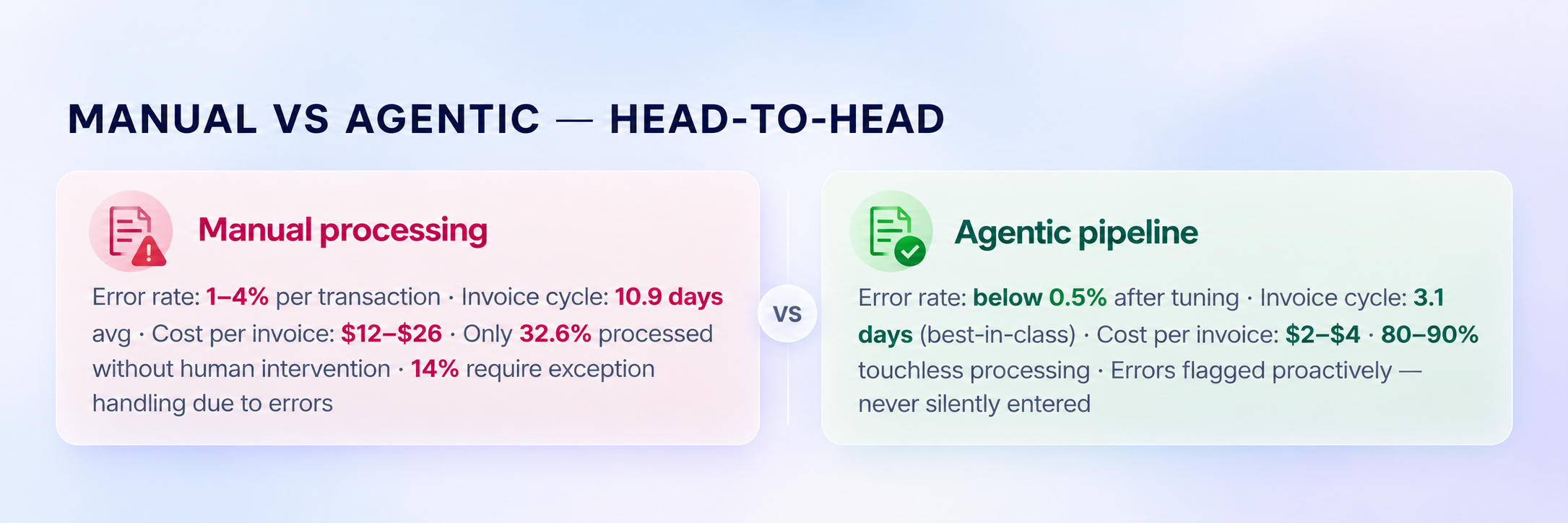
The average AP department currently takes 9.2 days to process a single invoice from receipt to payment, with 14% of invoices requiring exception handling due to errors or missing data. Only 32.6% of invoices are processed without any human intervention. Each of those numbers represents an addressable gap and every point of improvement in touchless processing rate translates directly to reduced labor cost, faster cash flow, and cleaner financial data.
Compliance, Auditability, and the Invisible Value of a Trail
Beyond the headline efficiency numbers lies a category of value that finance leaders increasingly cannot afford to ignore: auditability. 74% of AP departments plan to use AI in their processes in 2025, driven not only by cost reduction but by the growing regulatory expectation that every financial transaction can be reconstructed, justified, and presented to an auditor on demand.
Manual entry systems are, by nature, audit nightmares. Documents get misfiled. Approval chains go undocumented. The rationale for a payment decision exists in someone’s memory or, worse, in a chain of forwarded emails. When regulators or auditors ask questions, organizations scramble to reconstruct decisions from partial records.
Agentic pipelines create a complete, timestamped, immutable record of every document’s journey; when it arrived, how it was classified, what was extracted, what validation rules it passed or failed, who reviewed which exceptions, and when the system entry was written. Every touch is logged. Every exception decision is documented. Automated three-way matching delivers 70–80% reduction in matching time and prevents overpayments or duplicate payments, saving 1–3% of spend, while simultaneously creating the audit trail that regulators and compliance teams require.
This is not a side benefit. For organizations operating in regulated industries, financial services, healthcare, pharmaceuticals, government contracting, the audit trail produced by an agentic pipeline is increasingly the difference between clean regulatory reviews and expensive remediation exercises.
The Human Role, Redefined
The most persistent anxiety about document automation is the one that is simultaneously most understandable and most misplaced: that it eliminates jobs. The evidence, from organizations that have actually deployed end-to-end pipelines, tells a different story.
83% of knowledge workers say repetitive data entry negatively impacts their job satisfaction. The employees performing manual data entry are not fulfilled by the work. They are frustrated by it, aware that their skills could be applied to problems that actually require judgment and constrained instead to transcription tasks that a well-designed system could handle without them.
When agentic pipelines take over the ingestion, extraction, validation, and entry steps, human roles shift entirely. Staff manage the exception queue, reviewing the small percentage of documents that the system flags as ambiguous or anomalous. They improve extraction rules, refining the system’s performance over time based on what the exceptions reveal. They handle the genuinely complex documents that require contextual judgment no system can yet provide. They focus on vendor relationships, strategic analysis of AP data, and the compliance work that demands human accountability.
AP teams currently spend 21.8% of their time responding to supplier questions about invoices and payments; a reactive, low-value activity that automation largely eliminates by ensuring payments are accurate and on time in the first place. The time recovered doesn’t disappear. It redirects to work that is more skilled, more impactful, and more satisfying.
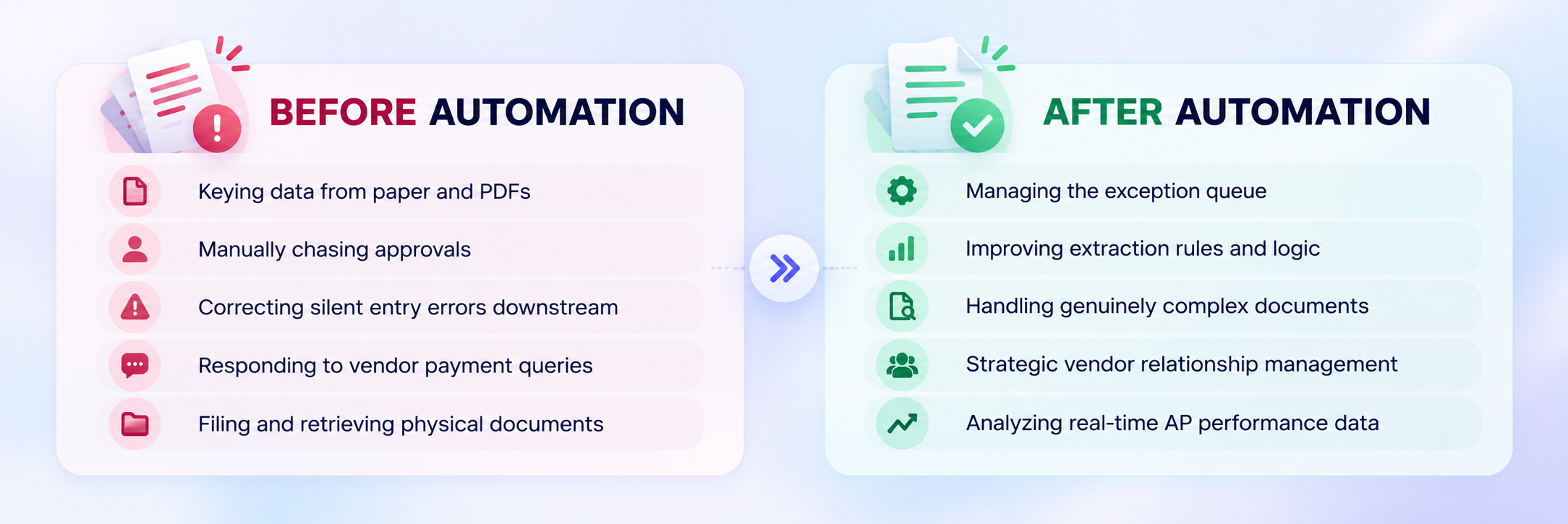
This is not a consolation argument. It is a genuine transformation of the role, from clerk to analyst, from transcriptionist to decision-maker. The organizations that frame it that way, and invest in training staff for the new responsibilities, are the ones building teams that want to work there.
The Window for Easy Wins Is Open — But Not Forever
The data entry automation market is projected to grow from $2.8 billion to $5.2 billion by 2033, while the RPA market grows from $3.79 billion in 2024 to $30.85 billion by 2030 at a 43.9% CAGR. The technology is mature, the ROI is proven, and the implementation playbook is established. Among companies already using automation, 96.5% report significant workload reduction.
The organizations that deploy agentic document pipelines now are not just eliminating a cost. They are building a data foundation, accurate, consistent, fully auditable, that compounds in value as it scales. Every quarter of operation improves extraction models. Every validated document strengthens the master data against which the next document is checked. Every exception review tightens the rules that govern the next thousand documents.
The cost of delay is equally compounding. Every month of continued manual entry is another month of 1–4% error rates quietly degrading the data that drives forecasting, reporting, and decision-making. Every invoice that takes 10.9 days to process is a missed early payment discount, a strained supplier relationship, and a cash flow lag that a competitor running a three-day automated cycle doesn’t share.
Manual data entry is not a problem that organizations can afford to manage carefully. It is a problem that agentic AI has made unnecessary. The death of manual data entry is not a prediction, it is a transition already underway in the organizations building the operational infrastructure of the next decade.