
Key Takeaways
- Agentic email systems go beyond assistance: they read, interpret, and act on emails autonomously, handling end-to-end workflows
- The shift from Inbox Zero to Inbox None is about delegation, not organization. AI owns the inbox, humans oversee outcomes
- Email is one of the highest-leverage areas for automation, with employees spending ~57% of their time on communication
- Adoption is accelerating rapidly: 79% of organizations already use AI agents and 96% plan to expand usage, signaling a near-term shift to mainstream deployment
- Agentic AI is delivering strong ROI, with average returns of 171% (up to 192% in the U.S.) and cost reductions of up to 70%
- Performance improvements are significant, with 4-7x increases in conversion rates and large reductions in manual email handling in high-volume environments
- The market is scaling aggressively, growing at a 43.84% CAGR from $5.25B (2024) to $199.05B (2034), making it one of the fastest-growing enterprise technology segments
- Multi-agent systems are becoming the dominant model, accounting for 66.4% of implementations, enabling coordinated, workflow-level automation
- Most failures occur at the workflow level (routing, escalation, permissions), not in text generation, making system design critical
- 40% of AI projects fail due to weak infrastructure, highlighting the importance of architecture, integration, and governance
- Human oversight remains essential — 89% of professionals emphasize human-AI collaboration, not full replacement
- The long-term shift is from managing communication → managing outcomes, redefining how teams operate and scale
Introduction
Every morning, the average person spends the first hour of their day just dealing with emails, a figure that has remained stubbornly consistent over the years despite waves of productivity tools. According to Microsoft, employees spend ~57% of their work time on communication with email being a primary contributor.
Traditional solutions, such as filters, folders, and priority inboxes have optimized organization, not ownership. Humans are still responsible for reading, interpreting, and responding to every message.

Agentic AI changes that equation. Instead of helping users manage email faster, it shifts responsibility entirely: AI systems now read, decide, and act on emails autonomously. This is the transition from Inbox Zero to Inbox None: not an empty inbox, but an inbox that no longer requires your attention.
How Agentic Email Systems Work
The core issue for readers is confusion: the term “email AI agent” is often mixed up with AI email assistants, writing copilots, or basic automation tools. While these categories overlap, they’re not identical. For teams evaluating solutions for a shared inbox or business workflows, these differences matter: they affect what the system can do, the level of access it requires, and how much human oversight is needed.
In simple terms, an email AI agent goes beyond generating text. It can read incoming messages, understand intent, and pull in context from other systems. Based on this, it can choose the appropriate course of action: draft or sometimes send responses and initiate follow-up tasks like creating tickets, updating a CRM, or escalating issues to a human.
Core Workflow
At a technical level, these systems follow a structured pipeline:
Email Ingestion → Context Understanding → Intent Classification → Action Planning → Response Generation → Execution → Feedback Loop
Key Concept of Agentic Email
Agentic email systems rely on AI agents to independently read, categorize, and act on emails, rather than simply suggesting replies. They work by analyzing incoming messages, interpreting intent, planning appropriate responses, and carrying out actions such as replying, scheduling meetings, or updating CRM systems. These agents can retain context over time and even collaborate in specialized roles like writer, editor, and publisher to manage complete workflows with minimal human involvement.
Core Components of Agentic AI Systems
Perception: Agents review incoming emails, attachments, and metadata, often connecting with platforms like Gmail or Outlook to access inbox data.
Reasoning (LLM): Large language models analyze the context, identifying the sender’s intent, tone, and level of urgency.
Action / Tools: Agents leverage APIs to carry out tasks such as updating CRM entries, scheduling calendar events, or sending responses.
Memory: The system maintains context from past interactions, allowing it to recognize prior conversations and ensure continuity over time.
How They Operate
Incoming Mail Analysis: The agent examines each incoming message to decide whether it needs a quick response, a scheduled meeting, or a more involved action.
Autonomous Decision-Making: It determines the appropriate next step: whether to ignore the email, act on it immediately, or wait for human approval.
Collaborative Workflow: Multiple agents can collaborate, with one drafting the message (writer), another refining tone and accuracy (editor), and a third handling delivery (publisher).
Reflective Adaptation: After execution, agents assess outcomes, such as recipient responses, to refine their approach and improve future performance.
Quantifying the Impact
Agentic email systems or autonomous AI tools that handle inbox management, drafting, and sending with minimal human oversight, are evolving beyond experimental, GenAI-based writing aids into fully capable, action-driven agents. The space is maturing quickly, with projections suggesting that 68% of customer interactions could be managed by agentic AI by 2028.
Key Adoption & Growth Stats
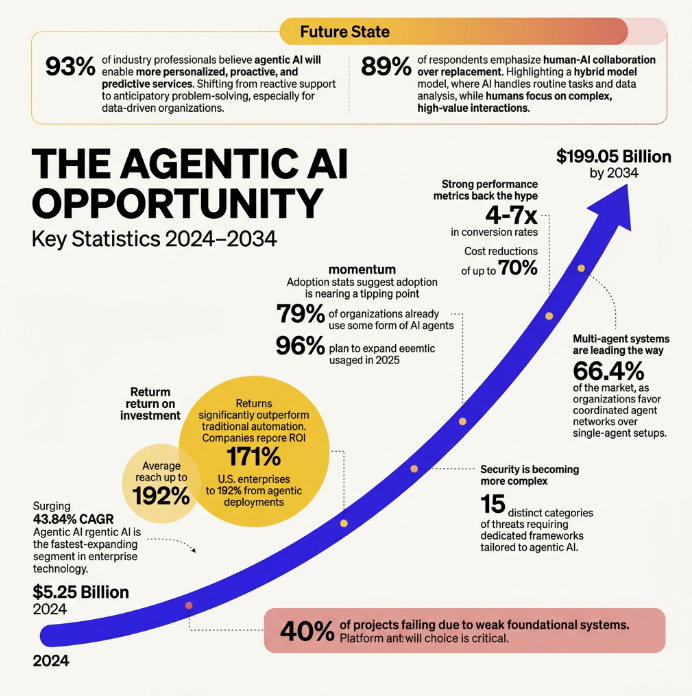
- The market is surging at a 43.84% CAGR, growing from $5.25 billion in 2024 to $199.05 billion by 2034, making agentic AI the fastest-expanding segment in enterprise technology
- Returns significantly outperform traditional automation, with companies reporting average ROI of 171%, and U.S. enterprises reaching up to 192% from agentic deployments
- Adoption is nearing a tipping point, as 79% of organizations already use some form of AI agents and 96% plan to expand usage in 2025
- Strong performance metrics back the hype, with 4-7x increases in conversion rates and cost reductions of up to 70%
- Infrastructure plays a decisive role, with 40% of projects failing due to weak foundational systems, making platform choice critical
- Multi-agent systems are leading the way, accounting for 66.4% of the market as organizations favor coordinated agent networks over single-agent setups
- Security is becoming more complex, with 15 distinct categories of threats requiring dedicated frameworks tailored to agentic AI
- 93% of industry professionals believe agentic AI will enable more personalized, proactive, and predictive services — shifting from reactive support to anticipatory problem-solving, especially for data-driven organizations
- 89% of respondents emphasize human-AI collaboration over replacement, highlighting a hybrid model where AI handles routine tasks and data analysis while humans focus on complex, high-value interactions

How to assess an email AI agent before deployment
A frequent mistake is judging email AI agents as if they were merely writing assistants. When a system is responsible for routing messages, interacting with customers, or triggering actions, the evaluation needs to extend well beyond writing quality or speed.
A more effective evaluation centers on how well the tool fits into your workflow, the level of control it offers, and how transparent its actions are. It’s important to understand what the agent can access, what it’s capable of executing, how it manages uncertainty, and whether your team can review and audit its behavior. This becomes especially critical in shared inbox environments, where errors can impact entire operations rather than just one individual.
Questions to ask before deciding
- What actions can the agent take independently without human oversight?
- Can it maintain context across threads and connect with external tools like CRMs, help desks, calendars, or task systems?
- Can permissions be restricted by inbox, workflow, action type, or environment?
- Does it include controls like draft-only mode, approval thresholds, or escalation paths?
- Is the solution built for individual use, shared inbox management, or full workflow automation?
If a vendor cannot provide clear answers to these, it typically signals a lack of operational readiness rather than just missing features.
Where Email AI Agents Add Value
The deciding factor is workflow fit. Agents are most effective in scenarios with high inbound volume, repeatable patterns, and clear rules for human review. The focus should be on structuring workflows that are measurable, predictable, and safe to automate.
Support and shared inbox triage: Agents can categorize messages, assess urgency, draft replies, and route tasks, significantly reducing manual sorting.
Sales, recruiting, and scheduling: These areas benefit from faster response times. Agents can identify intent, suggest replies, and coordinate next steps like follow-ups or interviews.
Inboxes for AI-driven systems: Some workflows require agents to operate their own inboxes for handling sign-ups, verification codes, receipts, or vendor communication.
The main risks and failure modes
A common mistake is assuming better text generation equals safer automation. In reality, most failures happen at the workflow level, such as incorrect routing, wrong recipients, poor escalation, or replies that sound right but miss context.
Wrong replies, bad routing, and over-automation: Incorrect replies are the most obvious risk, often caused by misinterpreted intent, outdated context, or inappropriate tone. Routing errors are less visible but equally damaging. Over-automation is another common issue — granting full send authority too early can amplify mistakes.
How to keep human review in the loop: Human oversight should be selective, not constant. Requiring approval for everything limits efficiency, while removing it entirely increases risk. A balanced approach includes starting with draft-only responses and automating low-risk tasks like tagging and summarization.
Conclusion
The shift from Inbox Zero to Inbox None is not just about efficiency, it represents a deeper transformation in how organizations handle communication. Email is no longer just a productivity burden to be optimized; it is becoming an operational layer that can be partially or fully owned by intelligent systems.
Agentic email systems demonstrate that autonomy in communication is both achievable and valuable, but only when implemented with discipline. The real advantage does not come from how well an agent writes, but from how reliably it understands intent, routes information, and executes actions within defined boundaries.
For most organizations, the path forward is incremental. Start with clearly defined workflows, introduce agents in low-risk environments, and build confidence through measurable outcomes. Over time, as systems prove reliable, autonomy can expand from assistance to execution.
The end state is not a fully automated inbox with no human involvement, but a rebalanced system where AI handles volume and repetition, while humans focus on judgment, relationships, and exceptions.