
Key Takeaways
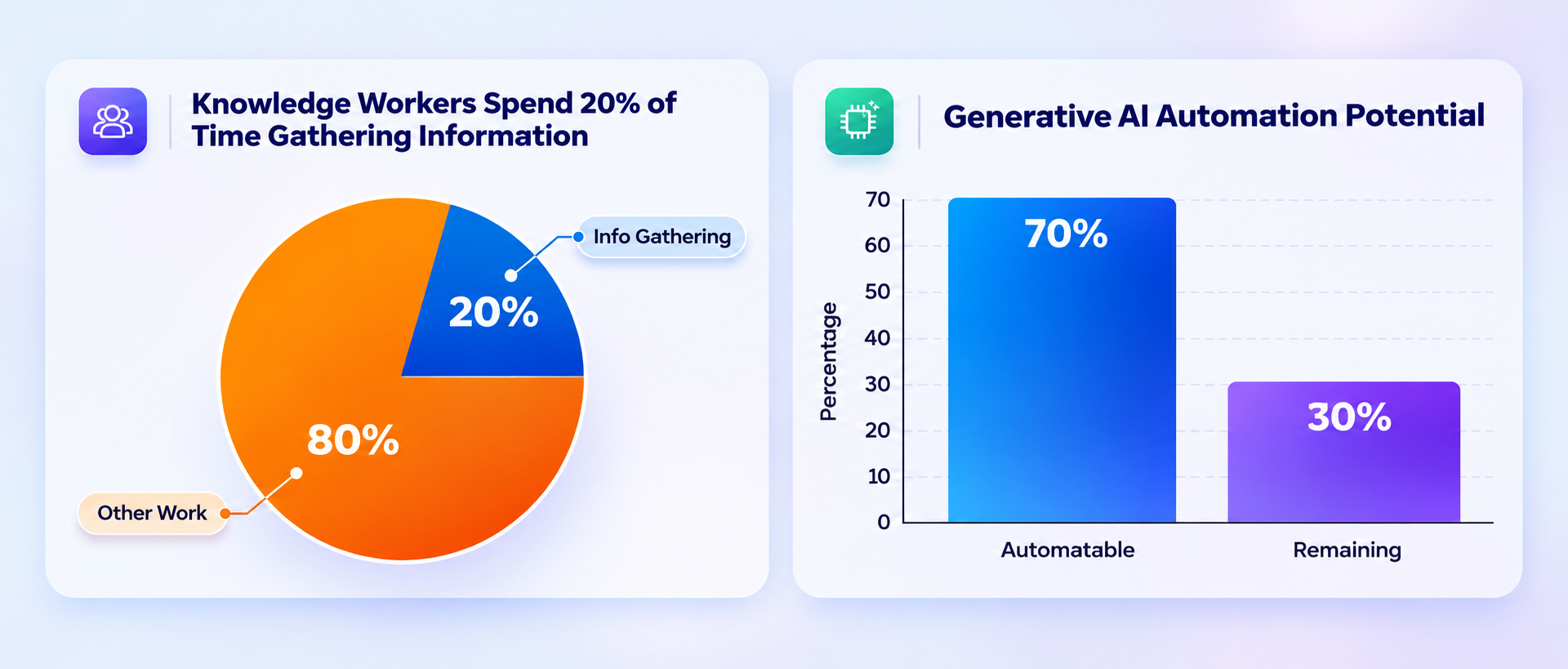
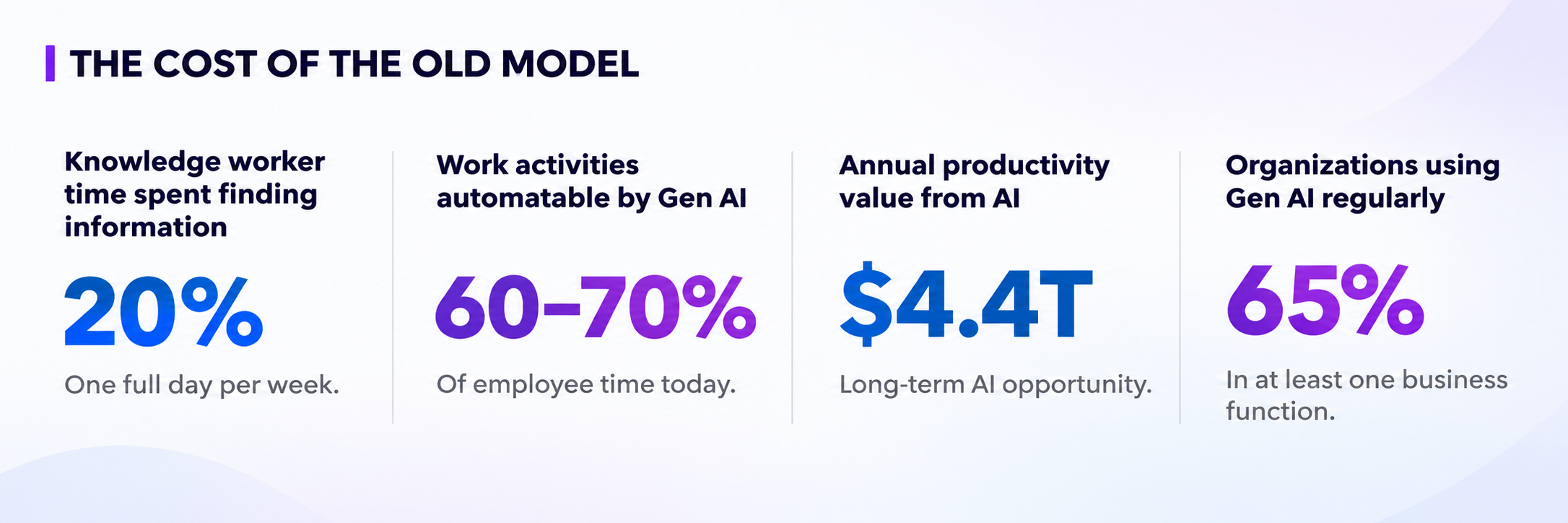
Knowledge workers spend 20% of their time gathering information, a process agentic AI can automate in hours.
Agentic AI transforms scattered research into actionable intelligence through synthesis, source validation, and confidence scoring.
AI automates secondary research, allowing analysts to focus on primary research and strategic interpretation.
AI represents a $4.4 trillion annual productivity opportunity, with 65% of organizations already using generative AI regularly.
Intelligence on demand removes lengthy research cycles, enabling faster, better-informed business decisions.
The Intelligence Bottleneck That’s Been Slowing Decisions for Decades
Every strategic decision an organization makes rests on a foundation of market intelligence. What are competitors doing? How is the target segment evolving? What regulatory shifts are coming? Where is the white space? The answers to these questions exist; scattered across news articles, analyst reports, regulatory filings, proprietary databases, and internal documents. The constraint has never been the existence of the answers. It has always been the time and human capacity required to find, evaluate, and synthesize them.
McKinsey Global Institute estimated that knowledge workers spend approximately 20% of their working time, a full day each week, searching for and gathering information. That is not research in the strategic sense. That is pre-research: the retrieval work that has to happen before synthesis can begin. McKinsey’s analysis of generative AI’s economic potential found that current AI technologies have the capacity to automate work activities that absorb 60 to 70% of employee time, with knowledge work, which requires understanding natural language and synthesizing information, representing the highest-value automation target.
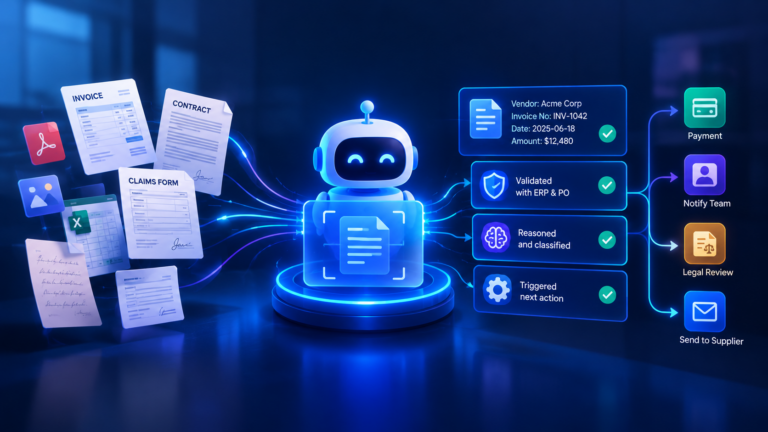
Market research sits squarely in that target. And agentic AI is now capable of running the full secondary research workflow, from a plain-language brief to a structured, decision-ready insight report, in hours rather than days or weeks. The implications for how organizations consume intelligence, and how quickly they can act on it, are profound.
The Old Model: Why Research Has Always Been a Bottleneck
Traditional market research operates on a project model. A business unit identifies a research need, submits a request to the research team or an external agency, briefs the project, waits for the team to source and screen data, waits again for synthesis and drafting, and receives a report, often weeks after the question was first asked. By then, the decision context may have shifted. The competitor who prompted the question may have already moved. The opportunity window may have narrowed.
The bottleneck is not analyst quality. It is process architecture. Secondary research, which constitutes the vast majority of most research projects, requires enormous amounts of time-consuming retrieval work before the genuinely skilled work of synthesis can begin. Analysts read dozens of sources to produce a handful of key findings. They manually reconcile conflicting data points. They format outputs, chase citations, and build presentation decks. These activities consume the majority of the research cycle while contributing a minority of the insight value.
McKinsey’s analysis identified this explicitly: if generative AI could take on information-gathering tasks, increasing the efficiency and effectiveness of workers doing them, the benefits would be enormous, with AI able to rapidly read vast libraries of information stored in natural language and scan source material in dialogue with a human who helps fine-tune and tailor the research output. Agentic systems take this further still, not as a passive tool a human prompt, but as an autonomous research engine that decomposes a brief, executes retrieval, evaluates sources, and produces structured output without manual coordination of each step.
How Agentic Research Actually Works
- Brief Decomposition: Converts a plain-language research brief into specific research questions, identifies key areas to investigate, and maps each question to relevant data sources.
- Parallel Retrieval: Searches across web, news, proprietary databases, and internal documents simultaneously, assessing source credibility, relevance, and recency.
- Source Validation: Identifies conflicting findings, evaluates information quality, and flags discrepancies instead of silently resolving them.
- Intelligent Synthesis: Connects insights across multiple sources, identifies emerging themes, highlights expert disagreements, and quantifies market estimates with confidence levels.
- Structured Reporting: Produces a decision-ready report organized around the original research questions, highlighting key findings, data gaps, and contested information.
The Synthesis Distinction: Why This Is Not Just Aggregation
The critical distinction between agentic market research and conventional search tools is synthesis, and it is worth examining carefully because it is where the strategic value of the approach is concentrated.
Search aggregation returns information. Synthesis produces intelligence. A search tool retrieves ten articles about the competitive dynamics in a target market. An agentic research system reads all ten, identifies the two points of genuine consensus, notes the three dimensions on which experts disagree, quantifies the market sizing estimate with a confidence range drawn from multiple methodologies, and flags the one data claim that appears in only a single source and cannot be corroborated.
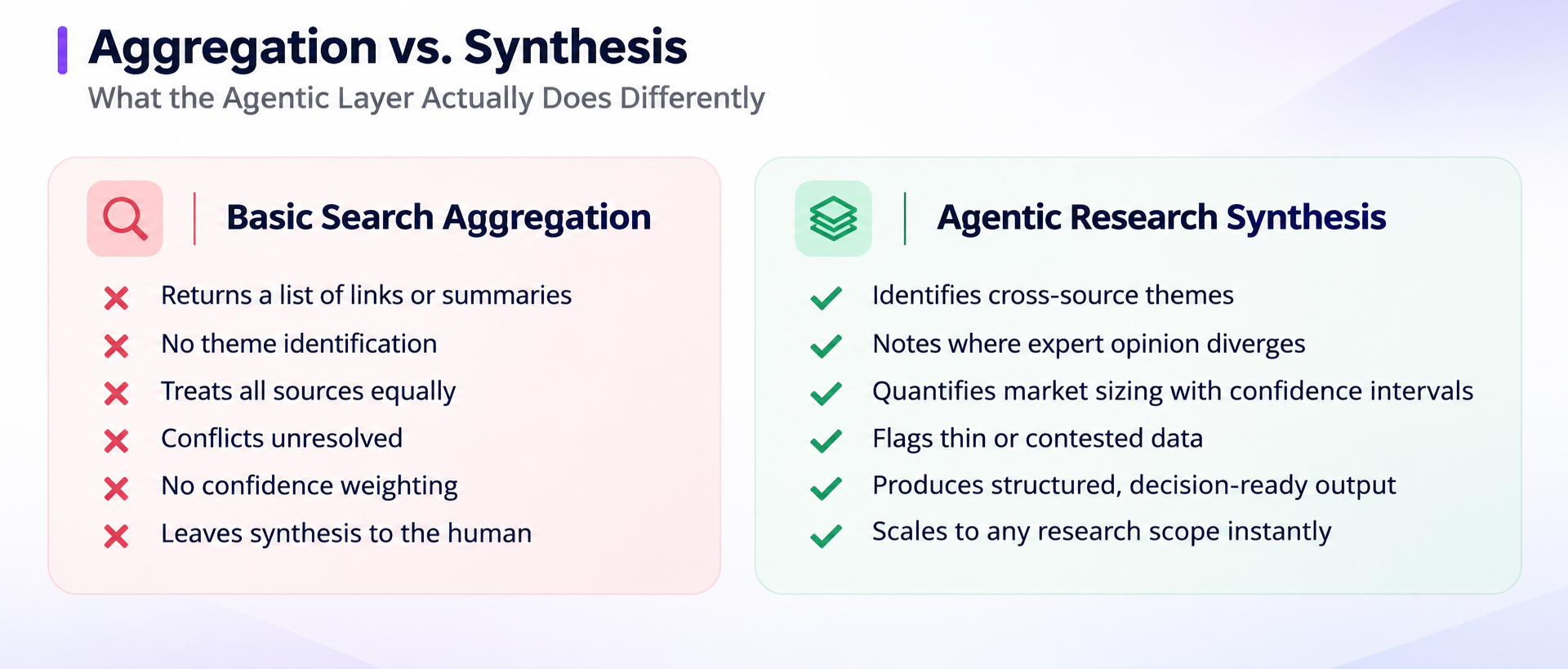
The difference matters enormously in practice. Decision-makers working from aggregated search results must still do the interpretive work, deciding which sources to trust, how to weight conflicting claims, and what the combined picture actually means for their strategic question. Decision-makers working from agentic synthesis receive that interpretive work already done, with the methodology transparent and the uncertainties explicitly named.
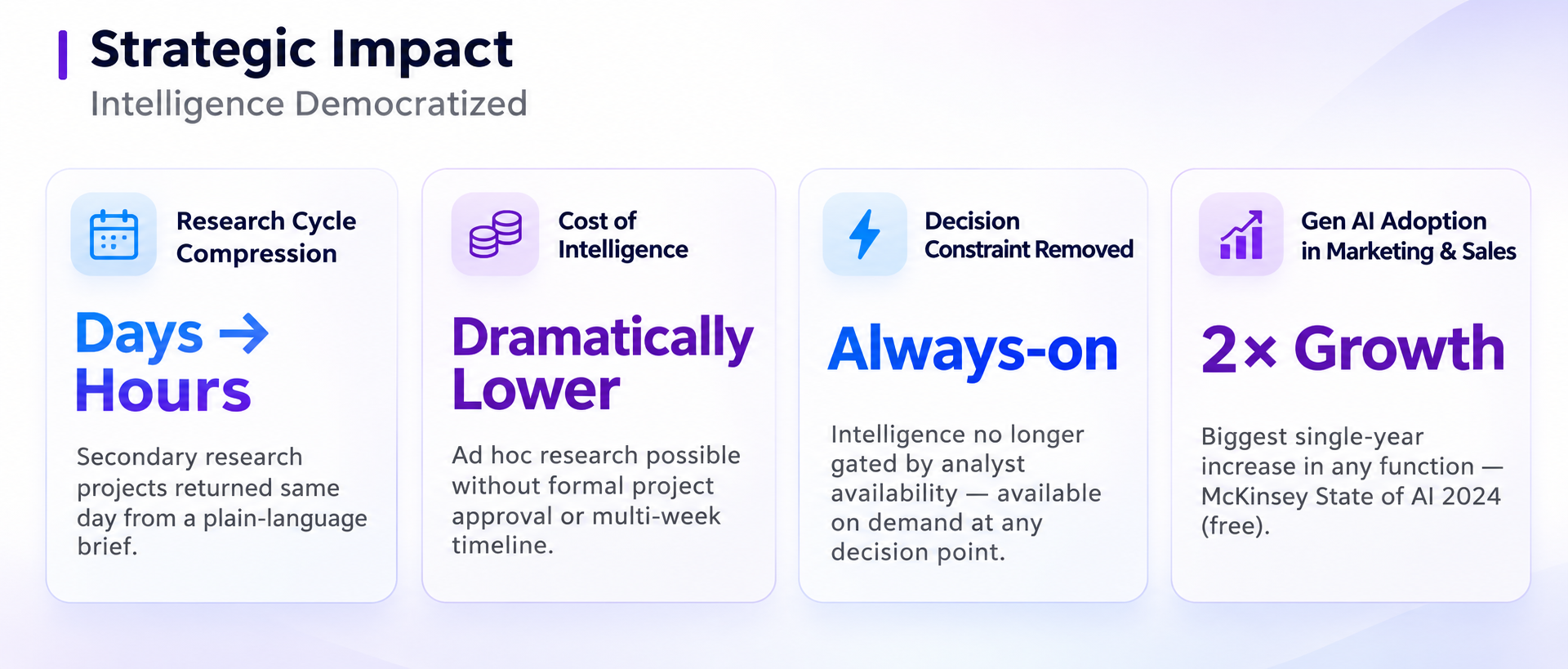
McKinsey’s 2024 State of AI survey found that 65% of organizations are now regularly using generative AI in at least one business function, with the biggest single-year adoption increase occurring in marketing and sales, where adoption more than doubled from the prior year.
Marketing and sales are precisely the functions that run on market intelligence, competitor awareness, customer segment understanding, product positioning data. The correlation is not coincidental: the functions that most depend on research intelligence are the first to adopt the tools that accelerate its production.
Where the Scope Ends — And Why That Matters
Intellectual honesty about agentic research requires clarity on its boundaries. Secondary research, the synthesis of existing information from accessible sources, is increasingly within the scope of agentic automation, and that scope continues to expand as retrieval systems improve and proprietary research databases become accessible through API integration.
Primary research, surveys designed to capture novel data, interviews with specific experts, focus groups exploring unarticulated customer needs, still requires human involvement at the design and execution stages. Not because AI cannot assist with these activities (it can, significantly, in instrument design, response analysis, and thematic coding), but because the value of primary research lies in the human judgment embedded in its construction and the trust relationships that enable its execution.
This boundary is not a limitation to be apologetic about. It defines where human research expertise is most valuably deployed. When the retrieval and secondary synthesis work that currently consumes the majority of research time is automated, analysts are freed to invest that time in the primary research design, the expert relationship management, and the strategic interpretation that represents the actual ceiling of their professional contribution.
The Strategic Implication: Intelligence on Demand
McKinsey sizes the long-term AI opportunity at $4.4 trillion in added productivity growth potential from corporate use cases and the democratization of market intelligence is one of the most direct paths to that value. When the cost of intelligence drops from a multi-week project to a same-day deliverable, the volume of decisions that can be made with adequate information increases dramatically. Organizations stop making high-stakes choices from intuition because the research cycle was too slow to inform them. Product teams stop shipping into markets they haven’t fully characterized. Strategy teams stop relying on last year’s competitive analysis because commissioning a new one felt too expensive.
McKinsey’s analysis frames the fundamental shift precisely: generative AI’s ability to rapidly digest large volumes of data and draw structured conclusions from it enables it to offer insights and options that can dramatically enhance knowledge worker productivity, acting as a scalable alternative to hiring a team of human experts for information-intensive tasks.
The organizations building agentic research capability into their strategy, product, and business development functions are not simply running faster versions of their existing research processes. They are removing intelligence as a constraint on decision-making. Every team, at every level, with access to an agentic research system can initiate a research question and receive a structured answer the same day, without a project request, without a multi-week timeline, and without the bottleneck of analyst capacity.
The competitive advantage this creates is not the quality of any single research report. It is the cumulative effect of better-informed decisions, made faster, across every function that previously waited weeks for answers to questions that can now be answered in hours.