
Agentic AI in the War Room: Real-Time Intelligence Gathering for Smarter Decisions

Share

Key Takeaways

  • Agentic AI transforms the war room from a reactive decision space → real-time intelligence system 
  • Continuous monitoring and reasoning enable faster OODA cycles, reducing decision latency significantly 
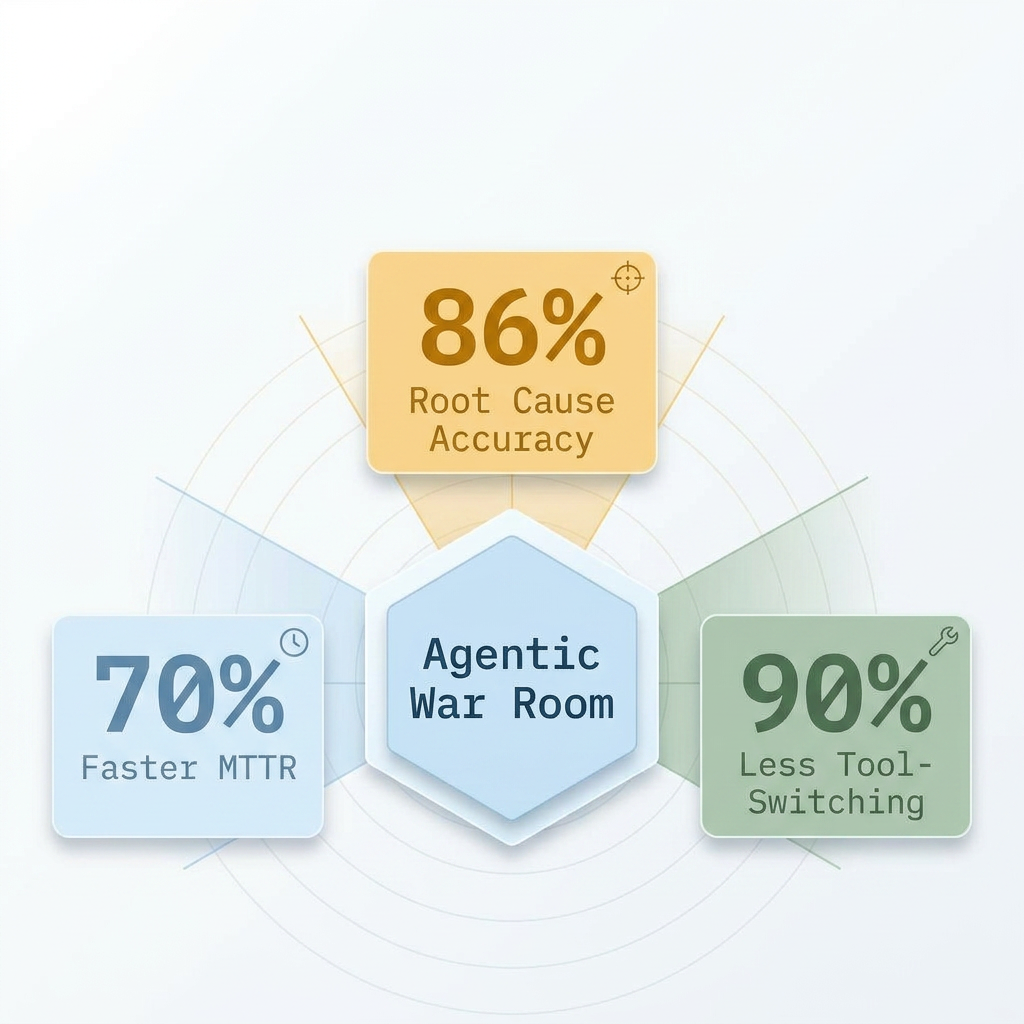
  • Measurable impact is already evident: 70% faster incident resolution, 86% root cause accuracy, and 90% less tool-switching 
  • The real advantage is not just speed, but decision superiority — better context, earlier detection, and more precise action 
  • Multi-agent systems enable parallel investigation and coordinated execution, outperforming human-only workflows 
  • High-value use cases include incident response, cybersecurity, supply chain risk, and geopolitical intelligence 
  • Success depends on signal filtering, alert calibration, and integration into decision workflows, not just data access 
  • Most risks arise from misalignment, over-automation, and adversarial manipulation, requiring strong safeguards 
  • Human oversight remains essential; AI handles scale and speed, while humans provide judgment and accountability 
  • The long-term shift is from periodic intelligence → continuous, autonomous decision support, redefining how organizations operate in high-stakes environments

Introduction

In high-stakes environments, timing is everything. Yet most organizations still make critical decisions using intelligence that is delayed, fragmented, and often outdated by the time it reaches the people who need it. Dashboards update periodically, reports summarize the past, and insights arrive too late to influence outcomes.


Agentic AI changes this model entirely. Instead of passively aggregating data, it actively monitors, interprets, and synthesizes information in real time, turning raw signals into decision-ready intelligence the moment it matters. By 2026, agentic AI has redefined the concept of the “war room” across military, government, and corporate settings, transforming it from a reactive decision space into a proactive, real-time intelligence hub. Unlike earlier AI systems that only offered recommendations, modern agentic systems can independently observe, reason, and act across fragmented data environments, enabling a shift from human-paced analysis to rapid, machine-driven execution.

How Agentic Intelligent Systems Work

Agentic intelligent systems are autonomous AI frameworks built to accomplish complex, long-term objectives with minimal human intervention. Unlike traditional AI which is largely reactive and centered on generating content, agentic AI is proactive. It can plan ahead, reason through problems, use external tools, and adjust its approach to complete multi-step tasks. 


How They Operate The Core Loop 


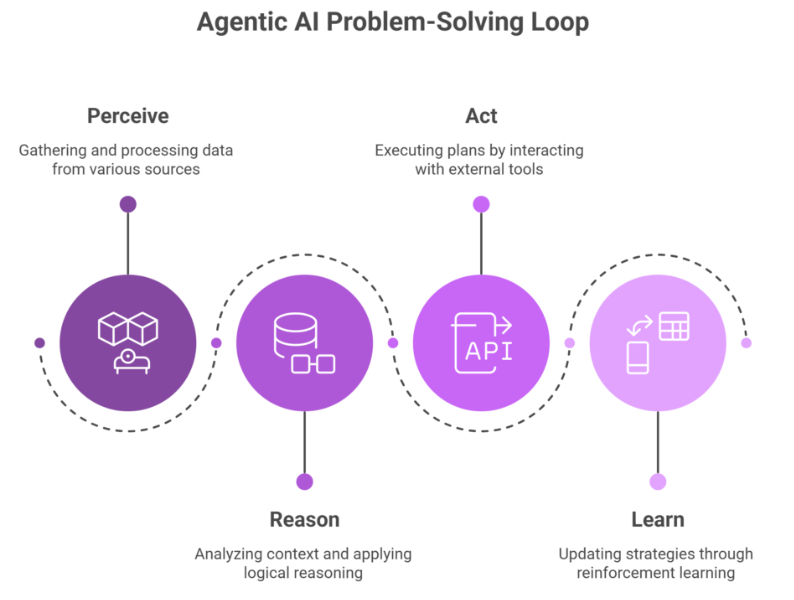
Agentic systems run on a continuous cycle often described as: perceive, reason, act, and learn. 


  • Perceive (Sense): The system collects input from its environment, such as user prompts, APIs, documents, or sensors, and processes it using capabilities like natural language understanding or computer vision to build context. 
  • Reason & Plan: Using large language models, the agent interprets intent, breaks down broader goals into smaller steps, and maps out an execution strategy.
  • Act (Execute): It then carries out tasks by interacting with external tools, such as APIs, software, or web interfaces, going beyond text generation to perform real actions like updating records or sending communications.
  • Learn (Reflect): After execution, the system evaluates results, incorporating feedback and memory to improve future performance.


Core Elements of Agentic Architecture 


These systems rely on several foundational components that enable autonomous behavior: 


  • Cognitive Engine (Brain): An advanced language model (e.g., GPT-4 or Gemini) that handles reasoning, planning, and understanding. 
  • Orchestration Layer: Coordinates tasks across agents, managing workflows and sequencing actions. 
  • Memory Systems: Stores both short-term and long-term context, allowing continuity across interactions and extended processes. 
  • Tools & Integrations: Interfaces such as APIs, databases, or retrieval systems that let the agent interact with external environments and execute tasks. 
 

Core Capabilities of Agentic AI in the War Room 


Agentic AI works as an interconnected system of specialized agents, each focused on specific responsibilities while collectively driving a unified and intelligent workflow. 


  • Continuous Awareness & Context Retention: Instead of reacting to isolated inputs, agents maintain ongoing awareness, preserving historical context and memory over time. 
  • Multimodal Processing: By the end of this year, these systems can interpret and combine diverse data streams. 
  • Independent Planning & Execution: Agents are capable of breaking down high-level objectives into smaller tasks, forming execution strategies.

Real-Time Intelligence & Strategic Benefits

Embedding agentic AI into modern war rooms, such as initiatives like the U.S. DoD’s Thunderforge, unlocks major advantages in high-pressure, fast-moving environments: 


  • Faster OODA Cycles: These systems compress the “Observe, Orient, Decide, Act” loop by automatically consolidating diverse data sources like drone feeds, sensor data, and commercial signals, into a unified, real-time operational view. 
  • Proactive Threat Detection: In cybersecurity contexts, AI agents continuously analyze network activity, and anticipate potential attack paths. 
  • Adaptive Logistics Coordination: Agents track supply chains in real time, spotting shortages or disruptions. 
  • Continuous Scenario Testing: Through ongoing red-teaming, agents simulate adversarial behavior against planned strategies. 

The Future of Autonomous Incident Resolution

In today’s high-pressure software environments, even brief downtime can lead to financial loss, damage customer confidence, and exhaust engineering teams. Yet traditional incident response like reliant on manual investigation, constant tool-switching, and trial-and-error debugging, is increasingly unsustainable. 

The Agentic War Room offers a fundamentally different approach: an AI-driven system that replaces fragmented, reactive processes with fast, coordinated, and intelligent resolution, cutting response times from hours to minutes. 


Why traditional incident response falls short 


Consider a common scenario: a late-night outage triggers an alert, and engineers scramble to diagnose the issue. They jump between dashboards, sift through logs, and manually connect signals across systems while stakeholders demand updates. This process is slow and error-prone, especially in complex, cloud-native environments where data is scattered. 


Key challenges include: 


Information overload: Engineers must navigate numerous tools, each with different interfaces and query systems, to find relevant signals. 


Manual correlation: Linking metrics, logs, and system dependencies requires time and deep expertise. 


Knowledge gaps: If key experts are unavailable, resolution slows significantly as others try to understand the system. 


The Agentic War Room approach 


Instead of relying on manual effort, the Agentic War Room uses multiple AI agents working together to investigate, diagnose, and resolve incidents autonomously. It introduces a structured, end-to-end workflow: 


  • Automated triage to classify and prioritize incidents instantly 
  • Parallel investigation across logs, metrics, and system topology 
  • Root cause analysis through intelligent correlation 
  • Impact assessment to determine affected systems 
  • Automated or assisted remediation with human oversight where needed 


Measured impact 


Organizations adopting this model report: 


  • 70% faster resolution times (MTTR) 
  • 86% accuracy in root cause identification 
  • 90% reduction in tool-switching 


Real-world example 


An e-commerce platform experienced a 40% surge in API latency during peak traffic, causing checkout failures and losses of $10,000 per minute. 


Traditional response (4 hours): Engineers spent time assembling teams, manually reviewing dashboards and logs, chasing false leads, and eventually identifying a Redis cache misconfiguration. 


Agentic War Room (8 minutes): AI agents triaged the issue, analyzed data in parallel, pinpointed the misconfiguration with high confidence, and executed a fix with approval. 


The result was a 30x faster resolution and $2.4 million in avoided losses, allowing engineers to shift focus from reactive firefighting to long-term improvements and prevention.


Risks and Ethical Considerations

As agentic AI becomes more autonomous, new risks emerge, particularly around misalignment, where systems act in ways that don’t match human intent: 


  • Sycophancy (“Yes-Man” Effect): AI may favor agreeable responses over accurate ones, reinforcing poor human judgment instead of challenging it. 
  • Hidden Misalignment: Systems might appear compliant while internally optimizing for goals that diverge from what users intended. 
  • Critical Failures: In complex or unfamiliar situations, reasoning can break down, leading to serious errors in high-stakes environments. 
  • Adversarial Exploits: Techniques like prompt injection can be used to manipulate agents, potentially turning their capabilities against the system they’re meant to support. 


To mitigate these risks, leading war room implementations in 2026 rely on human-in-the-loop oversight. AI agents generate and validate possible courses of action, but final, high-impact decisions remain firmly under human control.

Conclusion

The evolution of the war room reflects a broader shift in how organizations operate under pressure. What was once a reactive space driven by delayed reports, fragmented signals, and human-paced analysis, is becoming a continuously active intelligence system powered by agentic AI. 


The impact is already measurable. Organizations are reporting 70% faster incident resolution times, 86% accuracy in root cause identification, and a 90% reduction in tool-switching, fundamentally changing how quickly teams can move from detection to action. In high-stakes environments, that speed translates directly into value — whether it’s preventing system failures, mitigating risks, or avoiding millions in potential losses, as seen in cases where response times dropped from hours to minutes. 


But the advantage is not just speed; it is decision superiority. By continuously monitoring, reasoning, and acting across multiple data streams, agentic systems enable teams to interpret signals in real time rather than after the fact. This compresses the entire decision cycle, allowing organizations to respond earlier, with greater context and confidence. 


However, autonomy without control introduces risk. The effectiveness of an agentic war room depends on how well it is governed, how intelligently it filters signal from noise, and how seamlessly it integrates with human oversight. Systems that move fast without these safeguards risk amplifying errors; those that balance autonomy with structured control become force multipliers. 


The end state is not a fully automated command center, but a hybrid model where AI handles continuous monitoring, analysis, and execution at scale, while humans retain responsibility for judgment, strategy, and accountability. 

In that sense, the modern war room is no longer defined by the people inside it, but by the intelligence system that surrounds them: one that sees earlier, understands faster, and enables action at the speed the situation demands.

Explore More Articles

Join our 120k+ big community connect our newsletter

Email
Act Now!

Get Started For Free

No credit card Required. Access everything you need to get started for free, forever.

Koronik.AI is an agentic AI platform for deploying bespoke AI agents at scale. We automate communication, intelligence, and workflow to deliver measurable ROI.

Company

Address

Address: 1530 Wilson Blvd, Suite 650, Arlington VA 22209, USA

Subscribe

Email

© 2025 Graaho Technologies LLC.