

Key Takeaways
- Eighty to ninety percent of enterprise data is unstructured and growing at 55–65% annually; yet 95% of businesses still struggle to manage it effectively. The cost of inaction is $3.1 trillion annually in poor data quality consequences.
- First-generation IDP understood document layout. Agentic IDP understands document semantics, enabling reliable extraction across any format, from SAP-generated PDFs to handwritten forms with variable fields.
- Agentic IDP goes far beyond extraction: it validates against business rules, detects anomalies, triggers downstream actions, and learns continuously from human review feedback.
- Proven industry results include insurance claims processing dropping from five days to four hours at 97% accuracy, 60% fewer legal research hours, $1.2M+ in annual healthcare savings, and 80% faster enterprise expense processing.
- The IDP market is on track from $3.2 billion in 2025 to $43.9 billion by 2034, organizations deploying agentic IDP now are building compounding data infrastructure advantages that grow with every document processed.
The Problem That Never Got Solved — Until Now
For decades, organizations have wrestled with a maddening contradiction at the heart of their operations: the most critical business information doesn’t live in their databases. It lives in documents. Contracts that define billion-dollar obligations. Invoices that move cash. Claims that determine customer loyalty. Reports that shape strategy. And for all of the enterprise software built to manage this information, the fundamental act of reliably reading it at scale has remained stubbornly, expensively manual.
The scale of the problem is staggering. According to Gartner, unstructured data represents an estimated 80 to 90% of all new enterprise data, and it is growing three times faster than structured data. An overwhelming 95% of businesses recognize unstructured data management as a significant problem, yet the gap between awareness and implementation capability remains wide. Meanwhile, the US economy loses approximately $3.1 trillion each year due to poor data quality; a figure driven in no small part by the cost of decisions made on information that was never properly extracted, validated, or acted on.
Intelligent Document Processing powered by agentic AI is finally closing that gap. And it is doing so not incrementally, but structurally.
Why Generation One Failed at the Edge
First-generation IDP systems were a genuine step forward and a genuine disappointment. Built on Optical Character Recognition (OCR) combined with fixed extraction templates, they delivered reliable results precisely when reliability was easiest: when documents followed predictable formats, arrived from known vendors, and conformed to expected layouts. Within those boundaries, they worked. Outside them, they collapsed.
A contract from a new supplier. An invoice with an unusual column structure. A handwritten claims form with fields in variable positions. Any of these would defeat the template-matching logic, route the document back to a human queue, and erase whatever efficiency gains the system had promised. The more document variety an organization encountered and high-volume industries encounter enormous variety, the more the automation rate eroded and the human workload crept back.
The underlying limitation was architectural, not incremental. Template-based systems understood position, where a field appeared on the page. They did not understand meaning; what that field represented in context, how it related to adjacent fields, or how to find it when the layout changed. That distinction, invisible in a controlled proof-of-concept, became the fault line that separated automation from exception handling at scale.
The underlying limitation was architectural, not incremental. Template-based systems understood position, where a field appeared on the page. They did not understand meaning; what that field represented in context, how it related to adjacent fields, or how to find it when the layout changed. That distinction, invisible in a controlled proof-of-concept, became the fault line that separated automation from exception handling at scale.
The Agentic Leap: From Layout to Language
Modern agentic IDP systems operate at a fundamentally higher level of abstraction. Rather than pattern-matching against templates, they reason about document semantics, the meaning and relational structure of information, not its coordinates on a page. The result is a system that can extract the same invoice fields whether the document comes from a Fortune 500 supplier’s SAP-generated PDF, a boutique vendor’s bespoke Excel export, or a crumpled paper form photographed on a smartphone.
This contextual understanding dramatically improves automation rates by generalizing across document variations that defeat template-based systems. LandingAI’s agentic document processing model reduced information search times by 90% while handling complex tables without gridlines; precisely the kind of unstructured, visually ambiguous content that breaks rule-based extractors entirely.
But the semantic extraction capability, impressive as it is, represents only the first layer of what agentic IDP delivers. The transformative shift is what happens after extraction.
Beyond Extraction: Validate, Detect, Act
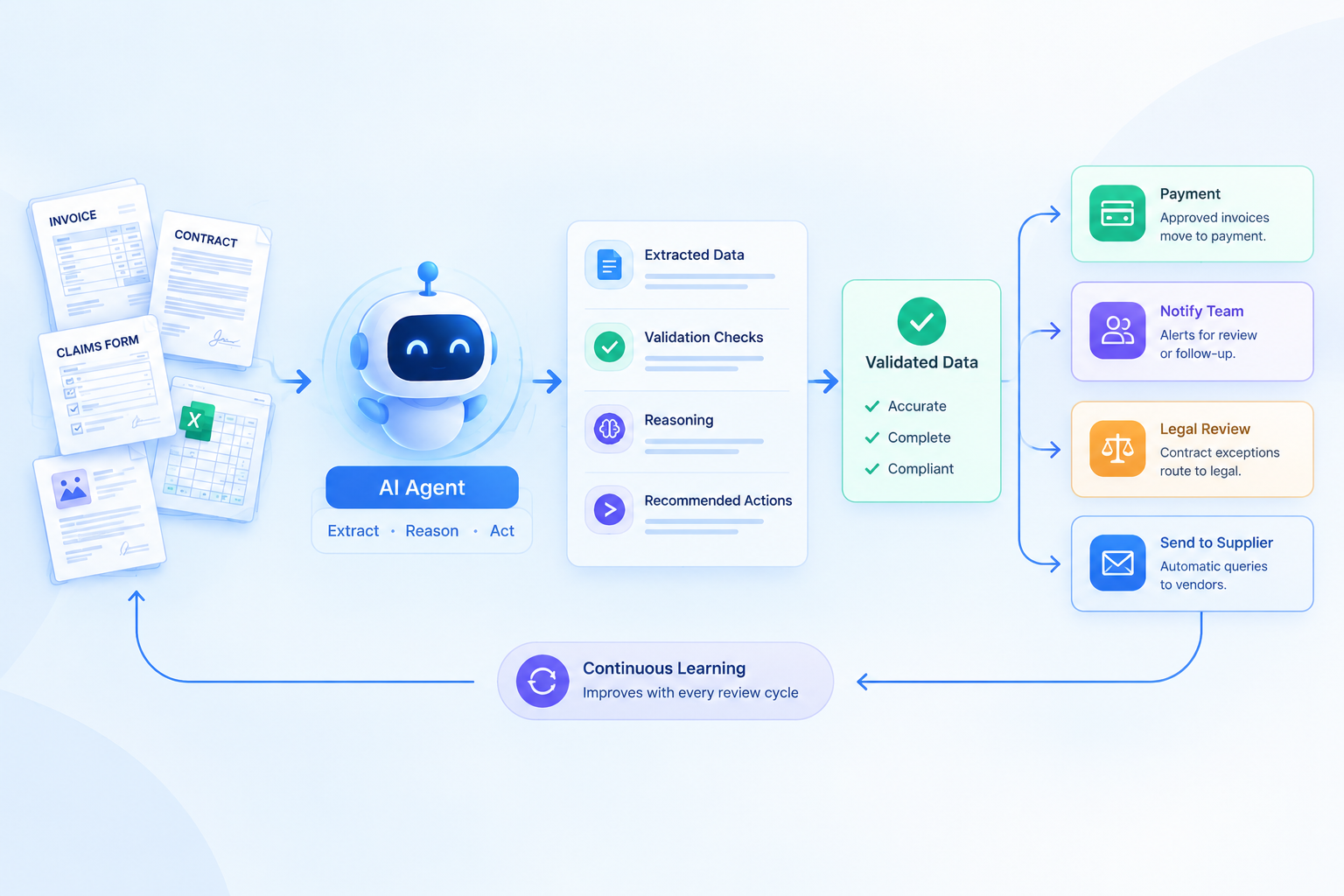
Legacy IDP handed off a data payload and considered its job done. Agentic IDP treats extraction as the beginning of a workflow, not its conclusion. The same system that reads a document can immediately validate what it has read; checking quantities against purchase orders, confirming vendor IDs exist in the ERP system, verifying that invoice dates fall within active contract periods, flagging line items that exceed approved spending thresholds.
When validation fails, agentic IDP doesn’t simply surface an error. It reasons about the discrepancy, distinguishing a missing field that can be queried from a vendor, from a quantity mismatch that requires procurement review, from a contract anomaly that needs legal eyes and routes accordingly. Downstream actions trigger automatically: an approved invoice proceeds to payment, a flagged contract exception routes to the legal team, a supplier query generates and sends without human intervention.
Applied to a major Korean enterprise, an integrated generative AI and IDP automation system demonstrated over 80% reduction in processing time for expense document tasks, alongside decreased error rates, improved compliance, and a virtuous cycle where the system progressively improved its exception-handling by learning from human judgments. This last dimension, the continuous improvement loop, is what separates agentic IDP from every prior generation of document automation. It doesn’t just process documents; it gets better at processing them with every review cycle.
The Industries Where the Returns Are Undeniable
The financial services, insurance, healthcare, legal, and logistics sectors share a defining characteristic: they run on documents, and the volume is relentless. These are the industries where the ROI case for agentic IDP is not theoretical, it is operational and compounding.
In insurance, the gains are vivid. Processing time for claims intake has dropped from five days to four hours in documented deployments, with extraction accuracy reaching 97%. What was once a multi-day, labor-intensive intake process, prone to delays, manual errors, and customer frustration, becomes a near-real-time operation that also improves accuracy rather than trading it for speed.
In legal services, BakerHostetler’s adoption of an AI-powered research tool cut research-related hours by 60%, freeing attorneys for higher-value client work. In healthcare, OSF HealthCare achieved $1.3 million in annual savings through ambient intelligence systems that automatically process clinical documentation, extract diagnostic insights, and update patient records without disrupting physician workflows.
The banking and financial services sector remains the single largest adopter. The BFSI segment leads IDP adoption because of its overwhelming volume of complex documents, loan files, KYC forms, claims, financial statements, and regulatory filings, where IDP enables banks and insurers to automate extraction, reduce compliance risks under AML and KYC mandates, accelerate onboarding, and minimize errors.
The market numbers reflect this urgency. The global IDP market, valued at $3.22 billion in 2025, is projected to reach $43.92 billion by 2034 at a CAGR of 33.68%, fueled by increasing demand for automation, AI integration, and digital transformation across financial services, healthcare, and government sectors. That trajectory is not driven by hype; it is driven by enterprise organizations discovering, deployment by deployment, that the returns are real.
The Data Problem Hiding in Plain Sight
One of the most consequential misalignments in enterprise technology investment is the gap between where data lives and where investment flows. Despite unstructured data accounting for 80% of all generated data, structured data receives 60% of total IT expenditure; a systematic underinvestment in the format that holds the majority of business-critical information.
This imbalance has real operational consequences. Dark data, information generated but never processed, never analyzed, never acted upon, accumulates silently across contract repositories, email archives, scanned document stores, and legacy filing systems. Every unread clause in an expired contract, every unvalidated field in a supplier invoice, every unextracted diagnostic note in a patient record represents a decision made without complete information, a risk not assessed, a compliance gap not closed.
Platforms incorporating semantic operators achieve 90% extraction accuracy without extensive prompt engineering, but this capability only generates value when organizations commit to the integration work that connects extraction to their existing ERP, CRM, and workflow systems. The technology is no longer the limiting factor. Deployment discipline is.
The Remaining Frontier: Ambiguity at the Edge
Intellectual honesty requires acknowledging where agentic IDP still earns human review. Truly novel document types, formats never encountered in training, and highly ambiguous content with contested or context-dependent interpretation still benefit from human oversight on low-confidence extractions.
This is not a limitation to be embarrassed about. It is a feature of a well-designed system. The confidence score that triggers a human review is itself a form of intelligence, a system self-aware enough to know the boundary of its own reliability. And the feedback loop from those reviews is not an operational cost; it is a strategic investment. Every human correction tightens the model’s calibration on the next document, compressing the exception rate quarter over quarter.
Hyland’s 2025 introduction of Agentic Document Processing, embedding semantic, context-aware AI for autonomous actions, represents the next frontier, moving from extraction and validation toward fully autonomous document reasoning. The direction of travel is clear: the proportion of documents requiring human review is shrinking, and the complexity threshold at which agents require assistance is rising.
The Strategic Window Is Now
The organizations that are treating agentic IDP as a genuine infrastructure investment, not a point solution for a single document type, are building a compounding advantage that their competitors will struggle to close. Every quarter of operation generates training data that improves the model. Every integration with an ERP or CRM extends the reach of automated validation. Every downstream action trigger eliminated from a human queue is a capacity gain that scales with volume, not headcount.
Industries such as finance, healthcare, legal, and logistics are adopting intelligent document processing to streamline workflows, accelerate decision-making, and optimize resource allocation, and the window for early-mover advantage remains open but is narrowing. The IDP market is consolidating around platforms that offer end-to-end agentic capabilities, and the gap between organizations that have deployed and those still evaluating is widening every quarter.
For decades, unstructured documents were the dark matter of the enterprise; present everywhere, influencing everything, but invisible to the systems that were supposed to run the business. Agentic IDP is making them visible, actionable, and as processable as any structured dataset. The organizations that act on that capability now are not just solving a document problem. They are building the data infrastructure that will power their next decade of operations.