

Key Takeaways
- High-volume, repetitive, clearly-scoped processes deliver the strongest agentic AI ROI; consistent 30–70% cost reductions with proven enterprise case studies across retail, legal, IT, and insurance.
- High-stakes, ambiguous, judgment-intensive work remains human territory; the best-performing full-automation agent achieves only a 2.5% success rate on complex end-to-end workflows.
- The messy middle, partially structured, error-tolerant, moderate-volume processes, is where implementation quality determines whether ROI materializes or evaporates.
- Measurement frameworks must track all four metrics: time saved, error rate versus human baseline, exception volume, and downstream business impact. Optimizing for technical metrics alone produces misleading signals.
- 40%+ of agentic AI projects will be canceled by 2027, the discipline of deploying within optimal range, measuring rigorously, and expanding deliberately is what separates compounding advantage from compounding cost.
The Honest Conversation Nobody Wants to Have
Agentic AI generates extraordinary excitement and equally extraordinary skepticism. Both are completely justified. Strip away the vendor hyperbole and the reactionary dismissal, and what remains is a technology that delivers genuine, measurable returns in specific contexts, and falls conspicuously flat in others. The difference between organizations that build a real competitive edge and those that burn capital on disappointment comes down to one discipline: knowing which category they’re operating in before they commit.
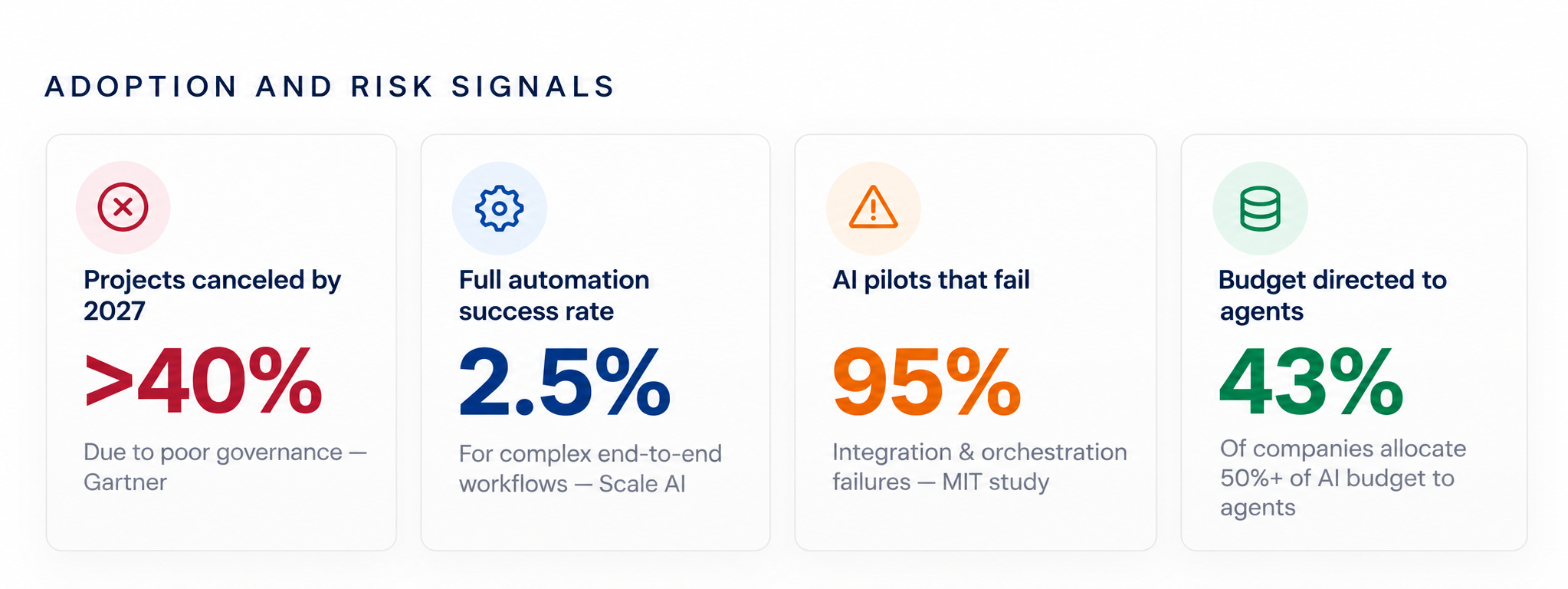
Companies are reporting average ROI of 171% on agentic AI deployments, with U.S. enterprises achieving around 192%, exceeding traditional automation returns by three times. Those numbers are real. So is this one: 95% of enterprise AI pilots fail, with root causes including poor integration with existing workflows, reliance on generic tools, and slow scaling within large organizations. Both statistics describe the same technology deployed in different conditions. The gap between them is not luck; it is decision quality.
Where Agentic AI Wins: The High-ROI Profile
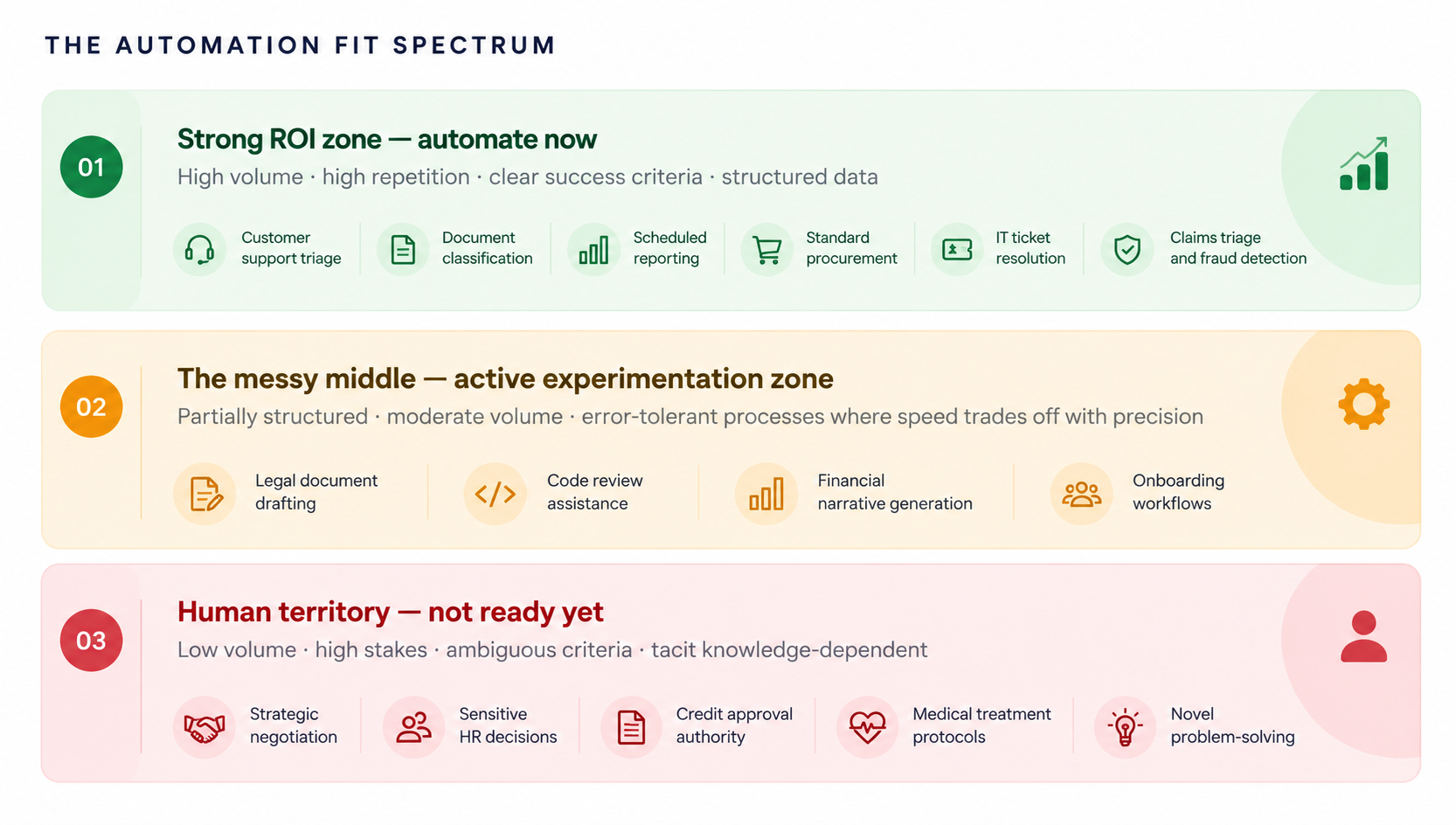
The strongest ROI cases for agentic AI today cluster around four characteristics: high volume, high repetition, clear success criteria, and access to structured data. When all four are present, agentic AI doesn’t just improve a process; it fundamentally transforms its economics.
Customer support ticket resolution is the canonical example. Agentic AI can reduce mean time to resolution by 30–50% through proactive ticket triage, dynamic prioritization, and automated resolutions. Enterprises report 20–40% fewer incoming tickets after implementing proactive agentic monitoring, and SLA compliance improves from 85% to over 95% in critical incident categories. Those are not marginal efficiency gains; they are structural cost reductions that compound as deployment scales.
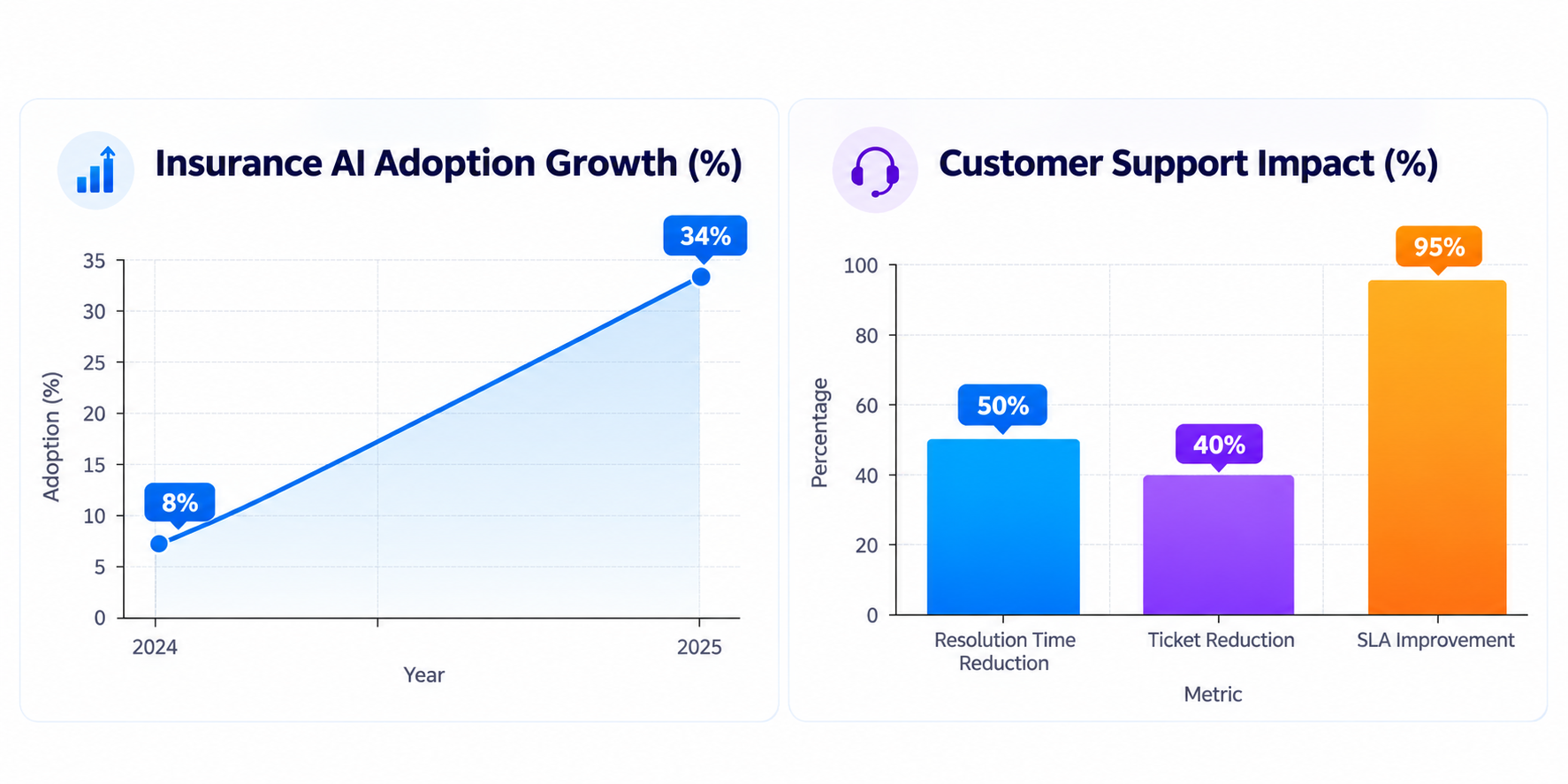
The pattern holds across industries. A Forbes-recognized retailer that deployed AI agents to handle customer communications saw a 9.7% increase in new sales calls and improved annual gross profit by $77 million, while calls to stores dropped by 47% and customer satisfaction rose, which reflected in an NPS score of 65. In legal services, Baker Hostetler’s adoption of an AI-powered research tool cut research-related hours by 60%, reduced case search times, and freed attorneys for higher-value client work. In insurance, the industry moved from 8% full AI adoption in 2024 to 34% in 2025, a 325% increase, driven by automated underwriting, claims triage, and fraud-detection workflows.
The throughline in every success story is the same: processes that were already structured, repetitive, and high volume. 71% of organizations deploying AI agents do so specifically for process automation; and the ones delivering results are doing so in environments where “structured data” isn’t aspirational but operational.
Where It Falls Short: The Limits Are Real

The weakest ROI cases share a different and equally consistent profile: low volume, high stakes, ambiguous success criteria, and dependence on tacit human knowledge.
Strategic negotiations, creative ideation, sensitive personnel decisions, medical treatment protocols, novel problem-solving; these remain firmly in human territory. Not because AI cannot generate outputs in these domains, but because the error cost is high and the judgment required is genuinely difficult to encode.
The highest-performing agent in Scale AI’s Replicate Labor Index achieved only a 2.5% success rate for full automation of complex workflows. Many of these projects fail because, as tasks are stitched together without human review in between, errors compound; and any time saved in the process is lost by needing human intervention to fix the end product.
In consumer lending, handing over full credit approval authority to an opaque AI system could be reckless. In healthcare, allowing autonomous agents to manage treatment protocols without human oversight is equally unacceptable. These aren’t failure modes of a specific product; they are structural constraints of the technology’s current state. The organizations that understand this are not paralyzed by it. They deploy agents where agents excel, and they keep humans precisely where human judgment is irreplaceable.
Unlike traditional software, AI models are non-deterministic; they can behave unpredictably, and their deployment across multi-cloud, multi-agent environments introduce new risks. Failures or breaches can lead to severe consequences, from data theft to erroneous decisions at scale. This is not an argument against agentic AI. It is an argument for deploying it with clear eyes about where its boundaries currently sit.
The Messy Middle: Where the Real Experimentation Is Happening
Between the clear wins and the clear limits lies the most strategically important territory — processes that are partially structured, moderately high volume, and tolerant of moderate error rates in exchange for speed. Legal document drafting, code review assistance, financial narrative generation, onboarding workflows. This is where ROI varies most dramatically based on implementation quality, and where the most active enterprise experimentation is occurring.
A consistent pattern from 2025: organizations either deployed agents on tasks too simple to justify the complexity, or on problems too high stakes to tolerate the current limitations of the technology. Both failure modes are avoidable with clearer thinking about where agents actually add value. The sweet spot is neither trivial nor critical; it’s the messy middle where work is too fluid and exception-heavy for traditional rules-based automation, but where the cost of an AI error is recoverable.
Bain’s 2025 Technology Report attributes the gap between AI investment and returns to fragmented workflows, insufficient integration, and misalignment between AI capabilities and business processes. Many early ambitions of 30–50% efficiency improvements haven’t materialized due to orchestration gaps. The lesson is not that the middle is unpromising; it’s that succeeding their demands implementation rigor that the easy wins don’t require.
The Four-Metric ROI Framework That Actually Works
The measurement gap in agentic AI is arguably as dangerous as the deployment gap. A systematic review of 84 papers from 2023–2025 reveals that technical metrics dominate assessments in 83% of evaluations, while human-centered assessments appear in only 30% and economic assessments in just 30%; with only 15% incorporating both technical and human dimensions. Organizations optimizing for the wrong metrics are making expansion decisions on misleading signals.
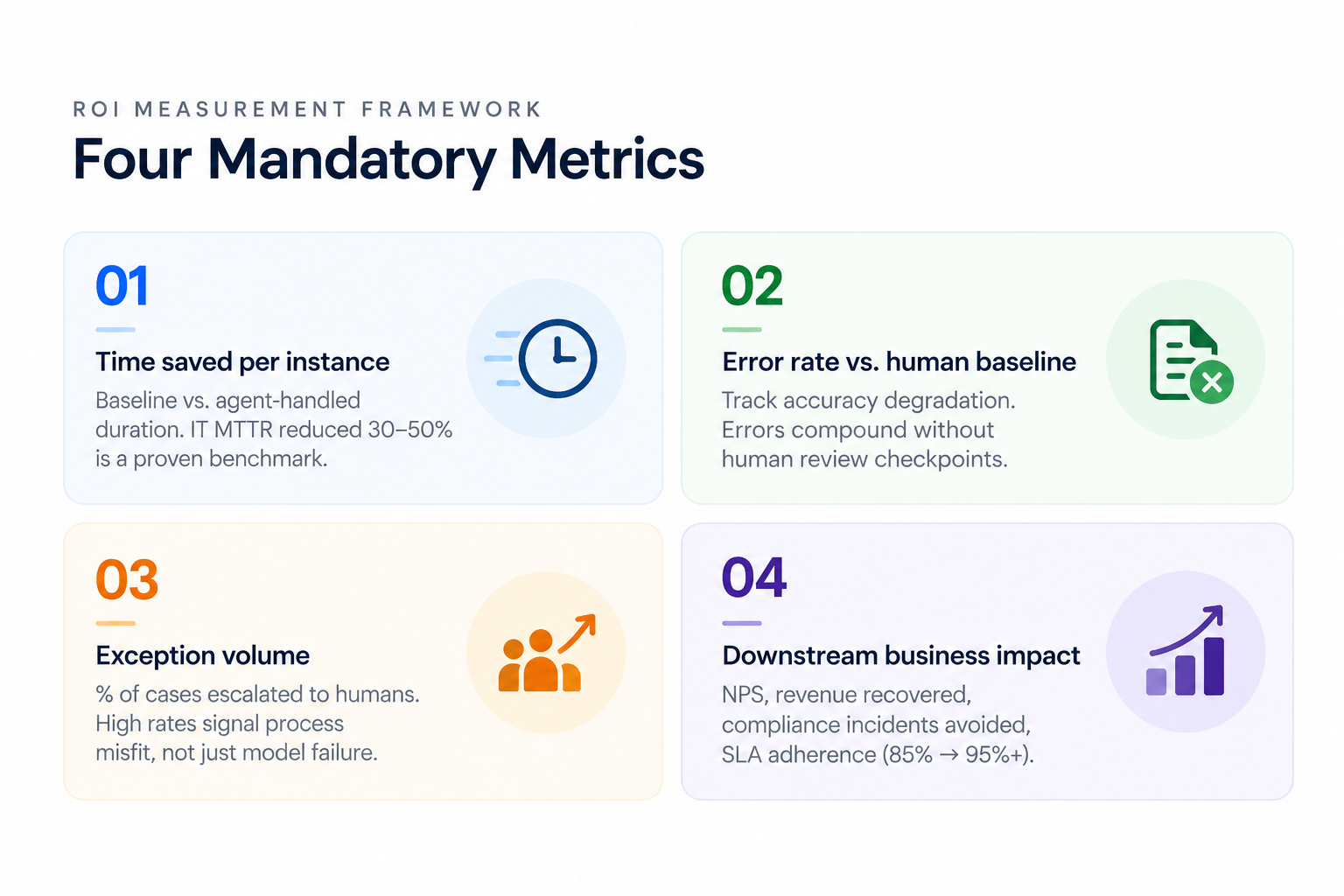
A rigorous ROI framework tracks four categories and none is optional.
- Time saved per process instance establishes the efficiency baseline. How long did this process take before? How long does it take now? Onboarding times for new agents can drop by 50%, and knowledge article usage increases by 30–40% when agentic AI captures tribal knowledge from senior staff and embeds it into dynamic workflows. Gartner
- Error rate compared to human baseline is where most organizations under-invest in measurement. Accuracy degradation is often invisible until it’s expensive. IT satisfaction scores rise 15–25% post-adoption when ticket volumes drop and resolution improves, but only when error rates are actively monitored and improvement loops are closed. Gartner
- Volume of exceptions requiring human intervention is the most honest signal of process fit. A high exception rate doesn’t necessarily mean the AI is failing, it may mean the process was misclassified as a strong-fit use case from the start. Either way, it’s data the organization needs.
- Downstream business impact is where the ROI conversation earns its seat at the executive table. Customer satisfaction scores, revenue recovered, compliance incidents avoided, SLA adherence improvements. The top drivers of AI value identified by Google Cloud’s 2025 study were productivity (70%), customer experience (63%), and business growth (56%). The organizations capturing that value have measurement infrastructure that goes beyond the agent pipeline itself and tracks what changes downstream.
The Deployment Discipline That Separates Winners from Cautionary Tales
Fully 86% of companies expect to be operational with AI agents by 2027. The question is no longer whether organizations will deploy agentic AI; it’s whether they’ll deploy it well. Gartner research suggests that more than 40% of agentic AI projects will be canceled by the end of 2027. The two statistics coexist without contradiction: mass adoption and mass failure are not mutually exclusive when the technology is deployed indiscriminately.
The problem with much of today’s agentic AI deployment is that organizations treat it as a more powerful tool for automating tasks; the modern equivalent of seeing railroads as faster canals. Agentic AI has the potential to redesign entire workflows, not just optimize individual steps within existing ones. A bank that deploys agents to save money on reconciliations is capturing a fraction of what the same technology could deliver if applied to redesigning the process around which reconciliations exist.
The organizations that will build genuine, durable competitive advantage from agentic AI share a common discipline. They start by mapping their processes against the fit spectrum, high-volume, structured, clear criteria first. They build measurement infrastructure before they scale. They treat exception rates as learning signals rather than failure indictments. And they resist the pressure to push agents into high-stakes judgment territory before the technology has earned that trust through performance in lower-stakes environments.
Organizations achieve up to 70% cost reduction by automating workflows with agentic AI, and these savings compound as implementations expand across business functions. But compounding only works if the foundation is sound. Deploy within the optimal range, measure rigorously, and expand deliberately. That is not a conservative posture, it is the only posture that turns the extraordinary promise of agentic AI into extraordinary returns.