
Key Takeaways
- Simple string passing between agents destroys context at every handoff; structured protocols preserve confidence, assumptions, error states, and intent across the entire pipeline.
- Metadata is not ancillary to agent communication; it is the mechanism by which receiving agents calibrate trust, handle uncertainty, and make appropriate escalation decisions.
- Four major protocols (MCP, A2A, ACP, ANP) are competing to define the interoperability standard, with broad enterprise adoption implications regardless of which wins.
- Gartner warns that 40%+ of agentic AI projects will be canceled by 2027; poor inter-agent communication design is a primary driver of the cost and governance failures that kill these projects.
- Protocol decisions made today are architectural foundations that will determine a pipeline’s debuggability, auditability, and scalability for years to come.
The Quiet Infrastructure Revolution
There’s a race happening right now that most boardrooms haven’t fully registered. And it isn’t about which AI model is the smartest; it’s about how AI systems talk to each other.
As multi-agent AI pipelines become the dominant architecture in enterprise automation, a deceptively unglamorous question is rising to the top of every serious AI architect’s agenda: What happens between agents? How does one autonomous system pass not just data, but intent, confidence, and context to the next? The answer is shaping up to be one of the most consequential design decisions in the history of intelligent software and the organizations paying attention today are quietly building the infrastructure that will define the next decade.
The numbers demand attention. The global AI agent market, valued at $5.1 billion in 2024, is projected to reach $47.1 billion by 2030, growing at a CAGR of 44.8%. Gartner predicts that 40% of enterprise applications will be integrated with task-specific AI agents by the end of 2026, and in the best-case scenario, agentic AI could drive approximately 30% of enterprise application software revenue by 2035, surpassing $450 billion. This is not incremental evolution. This is wholesale transformation and it runs on protocols.
The String-Passing Problem: Where Simple Pipelines Break
The first generation of multi-agent deployments shared a common architectural shortcut: plain text handoffs. One agent finishes thinking, writes a sentence or paragraph, and the next agent reads it and begins working. It’s elegant in its simplicity. And it’s completely insufficient for anything beyond toy use cases.
Imagine a customer service pipeline where Agent A classifies an incoming complaint as “billing dispute, medium urgency, customer sentiment negative.” It passes this as raw text to Agent B, which is supposed to escalate appropriately. But what happens when Agent A is only 54% confident in the urgency classification? What happens when it made an assumption about the customer’s account tier that it can’t verify? What if there’s an unresolved question about whether the refund policy from Q3 2023 still applies?
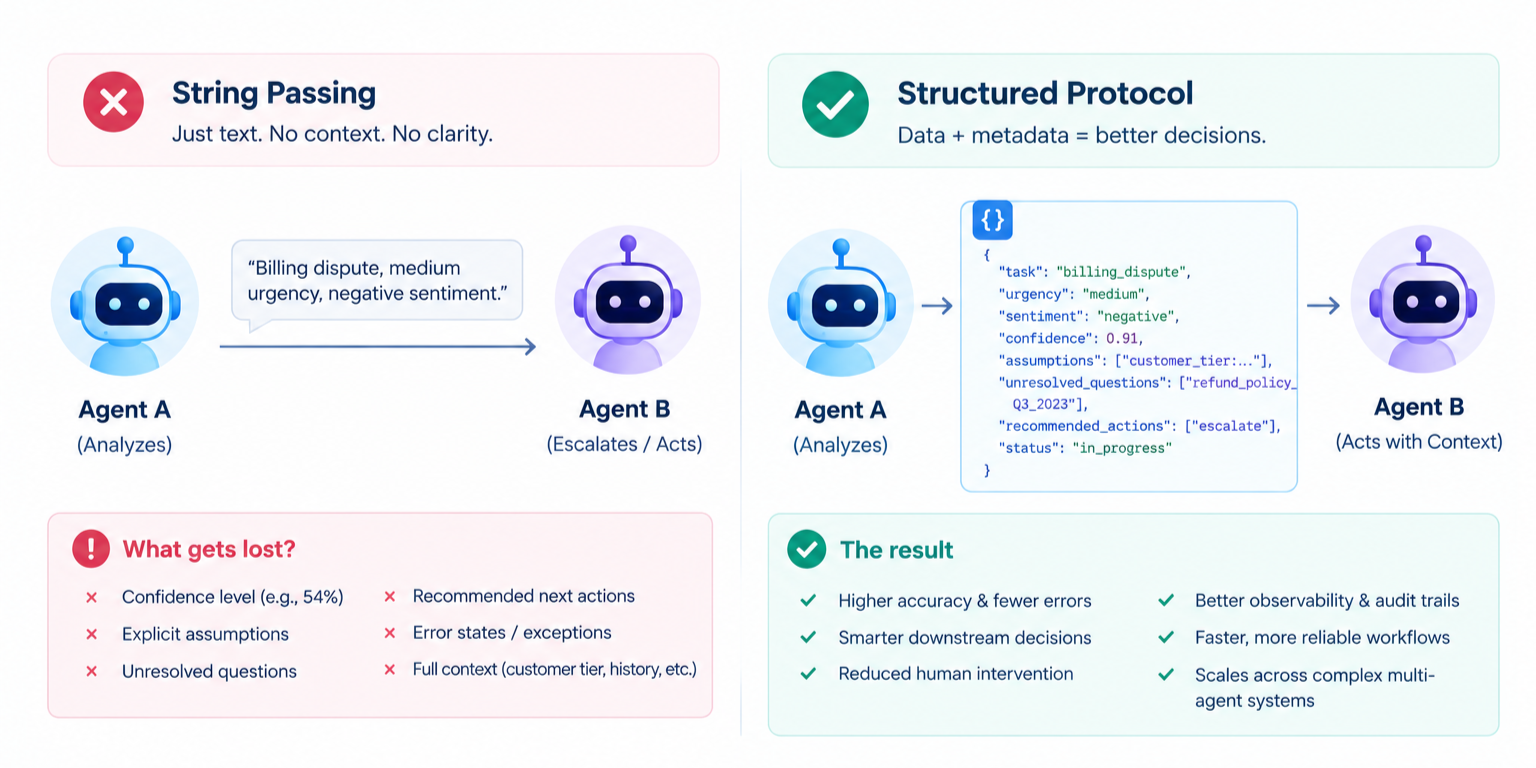
With string passing, all of that uncertainty evaporates at the boundary between agents. Agent B receives the text and acts on it as though it were ground truth. The result: downstream decisions made on degraded, context-stripped information; at machine speed, at scale, across thousands of simultaneous workflows.
Communication latency adds 50–200ms of additional processing time per inter-agent interaction, and 3–7% of decisions in complex multi-agent systems may require human intervention initially; but only if the system is designed to flag that uncertainty in the first place. When agents talk in bare strings, they can’t.
Structured Protocols: When Metadata Becomes the Message
The architectural evolution now underway inverts the old assumption. In sophisticated modern frameworks, the content of an agent handoff, the actual data or decision being passed, is only half the payload. The other half is metadata: structured information about the information itself.
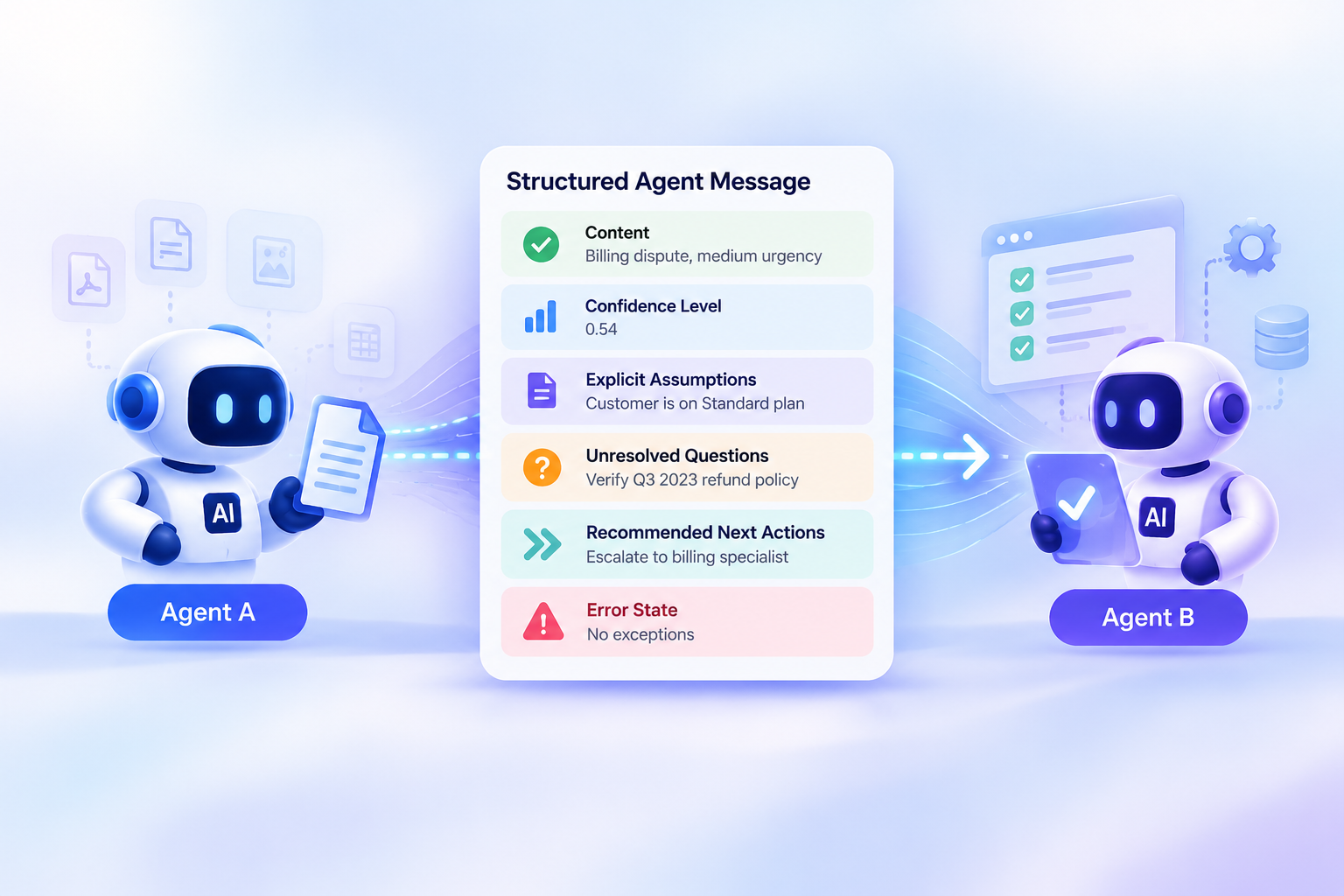
What does a well-designed inter-agent message look like? At minimum, it should carry:
Confidence levels: How certain was the originating agent about its conclusions? A confidence score of 0.91 versus 0.54 should trigger fundamentally different downstream behavior and the receiving agent needs to know which one it’s working with.
Explicit assumptions: Every AI agent makes assumptions during processing. In unstructured handoffs, these assumptions are invisible. In structured protocols, they’re surfaced and logged; allowing receiving agents (and human auditors) to interrogate them.
Unresolved questions: What did the originating agent not know? Flagging knowledge gaps explicitly prevents receiving agents from confidently proceeding on incomplete foundations.
Recommended next actions: Rather than leaving interpretation entirely to the receiving agent, the originating agent can signal which pathways it believes are most viable; while making clear these are recommendations, not mandates.
Error states: Was the output produced cleanly, or did the agent encounter exceptions it had to work around? This distinction matters enormously for downstream reliability.
Research from IBM indicates that structured Agent Communication Protocol (ACP) reduces integration errors by up to 40% in multi-agent environments. That reduction isn’t magic; it’s the direct result of context that would have been silently discarded in a string-passing system being preserved and transmitted instead.
The Protocol Wars: Who Writes the Grammar of AI?
Recognizing the strategic importance of this layer, major players have moved aggressively to define it. Two protocols are emerging as leading standards: Anthropic’s Model Context Protocol (MCP), which standardizes how agents connect to external tools, databases, and APIs, and Google’s Agent-to-Agent Protocol (A2A), which lets agents from different vendors discover each other’s capabilities and delegate tasks. IBM’s ACP defines agents by structured identity and scoped memory to enable trust and modularity. The open-source Agent Network Protocol (ANP) takes a decentralized approach to cross-organizational agent discovery.
If 2023 was the year of the LLM, 2024 quietly became the year of the protocol; companies investing not just in models that reason, but in systems that coordinate across teams, tools, and runtimes. These four protocols differ sharply in their assumptions about where trust lives and what interoperability means. That divergence is intentional and temporary. Just as HTTP eventually unified web communication, agent communication standards will consolidate under pressure from real-world enterprise adoption.
The Enterprise Stakes: A First-Order Architecture Decision
For most enterprise technology decisions, getting the details wrong is costly but recoverable. Agent communication protocol decisions are different. They are foundational in the truest sense: they determine whether a multi-agent system can be debugged when it behaves unexpectedly, extended when requirements change, audited when regulators ask questions, and trusted when the stakes are high.
Twenty-three percent of organizations are already scaling agentic AI systems somewhere in their enterprise, and an additional 39% say they have begun experimenting with AI agents. That combined 62% engagement rate means the majority of large organizations are already making protocol decisions; often implicitly, by adopting whichever framework their first proof-of-concept happened to use.
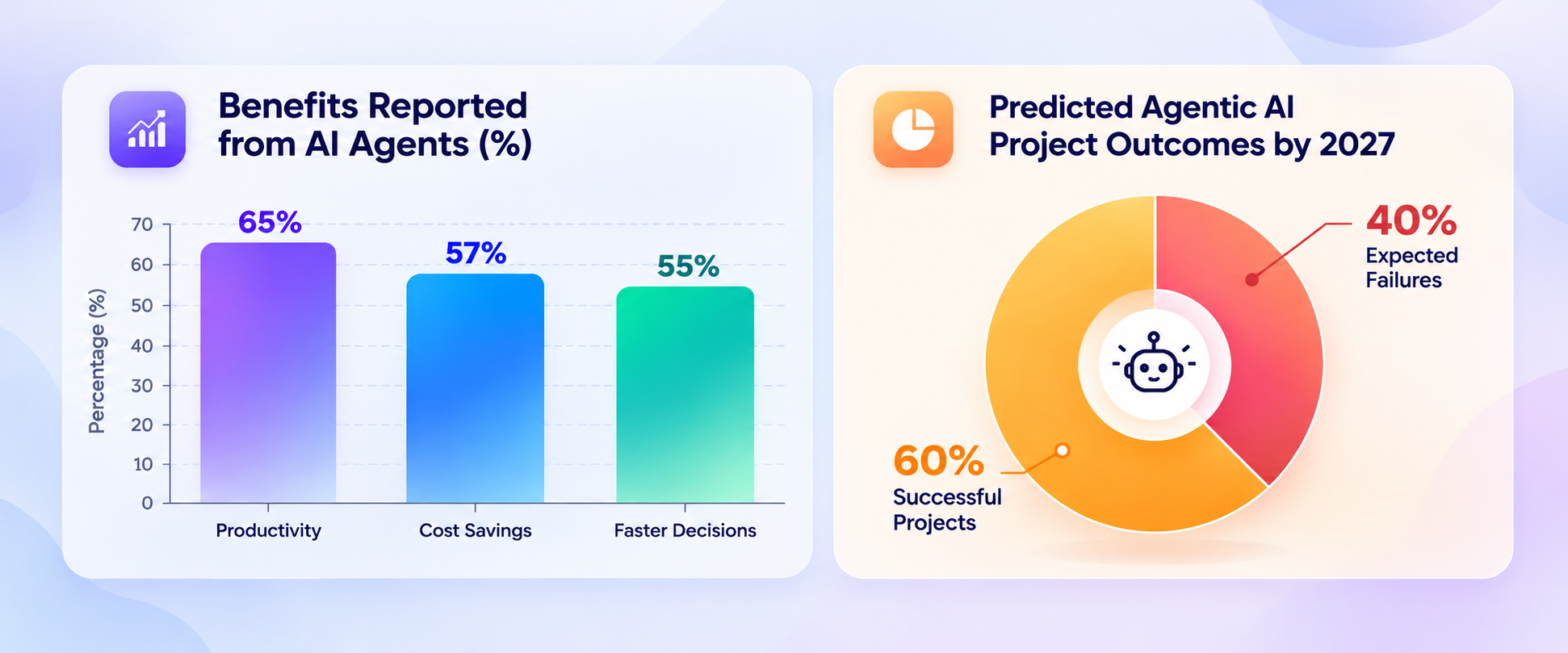
The cost of getting this wrong is substantial. Gartner predicts that over 40% of agentic AI projects will be canceled by the end of 2027, due to escalating costs, unclear business value, or inadequate risk controls. Poor inter-agent communication design sits at the heart of all three failure modes: systems that can’t be observed accumulate hidden costs, systems that can’t be audited fail to demonstrate business value, and systems built on ad-hoc string-passing resist the governance controls that risk management demands.
According to PwC’s 2025 AI Agent Survey, 66% of companies adopting AI agents report increased productivity, 57% report cost savings, and 55% report faster decision-making. But these gains are distributed unevenly; and the distribution correlates strongly with architectural maturity. Organizations that invested in clean agent communication from the start are realizing compounding returns. Those that didn’t are discovering that retrofitting protocol structure into an existing pipeline is only marginally easier than rebuilding it from scratch.
The Auditability Imperative
There is a regulatory dimension that’s easy to overlook in the excitement of capability-building. The US introduced 59 AI-related regulations in 2024, double the number from 2023; and regulators increasingly want to know not just what an AI system decided, but how, and on what basis.
A pipeline built on plain text handoffs is, by design, a black box. When a decision is challenged, by a customer, an auditor, or a regulator; there is no structured record of what each agent knew or what confidence it held. The metadata that well-designed protocols embed as first-class fields becomes, in regulatory terms, the equivalent of a paper trail. In financial services, healthcare, and legal applications, precisely where agentic AI promises its largest returns, this isn’t a nice-to-have. It is increasingly a compliance requirement.
Build for the Pipeline You’ll Have, Not the One You Have Today
Enterprise AI pipelines follow a predictable growth curve. They begin with two or three agents handling a contained use case. Success leads to expansion: more agents, more complexity, cross-functional handoffs, integration with legacy systems. The pipeline that felt manageable at launch becomes a dense, interdependent network where a miscommunication at one node can propagate silently across a dozen downstream decisions.
The organizations navigating this expansion successfully share a common characteristic: they treated inter-agent communication as an architectural concern from the beginning; not as plumbing to be figured out once the agents themselves were working. They defined their protocol vocabulary early, built metadata schemas that could accommodate new fields as requirements evolved, and invested in the observability tooling that makes a complex pipeline debugable.
McKinsey predicts AI agents could add $2.6 to $4.4 trillion in value annually across various business use cases. That value does not accrue automatically. It accrues to the organizations whose agent infrastructure is robust enough to scale; and that robustness begins with the unglamorous, consequential work of deciding how agents communicate.
The Language Is Being Written Now
The most important thing to understand about the current moment in agent communication protocols is its temporariness. The fragmentation that exists today, competing standards, incompatible frameworks, organization-specific vocabularies, will not persist indefinitely. Just as HTTP eventually standardized web communication and TCP/IP unified network transport, the agent communication layer will consolidate around interoperable standards.
The organizations contributing to that consolidation, through protocol adoption, through open-source participation, through the practical feedback of running large-scale agentic pipelines, will have shaped the grammar by which machines communicate for a generation. The organizations that arrive late will inherit a language they had no hand in designing.
The grammar of intelligent automation is being written right now, one agent handoff at a time. The architects who understand this and build accordingly are not just deploying AI systems. They are laying the infrastructure on which the next decade of enterprise intelligence will run.